Protein AI field guideArticle 4 of 7
Design the Chemistry Before the Scaffold
In a published RFdiffusion3 screen, 35 of 190 designs showed multiple turnovers. The result starts with a chemical brief and ends with an assay: a useful example for teams exploring a reaction that existing enzymes do not yet perform well.
- Evidence type
- Published-study walkthrough
- Published
- August 2026
Start with the chemistry the protein must support
An industrial enzyme team needs a reaction to work under useful conditions. A convincing fold is only part of that problem. The protein must position the substrate, support the chemistry, and keep doing so beyond a single reaction event. The assay endpoint belongs in the brief from the start.
In the RFdiffusion3 study, the enzyme brief was not a vague request for hydrolase activity. The authors specified functional atoms from a Cys-His-Asp catalytic triad, a glutamine, backbone atoms flanking the catalytic cysteine, and a substrate positioned in a tetrahedral-intermediate geometry.
The study screened an activated ester substrate. That is a useful demonstration of designed catalysis, but it does not establish activity on an industrial substrate or performance under process conditions. Those application requirements must shape a separate design brief.
From catalytic brief to measured turnover
Follow what computation proposes and what only the assay can show.
Loading author-released tutorial structure
Drag to rotate · scroll to zoom
Illustrative tutorial output
Functional design walkthrough
Hold the catalytic geometry
The design brief fixes the functional atoms of a Cys-His-Asp triad, a glutamine, neighboring backbone atoms, and a substrate-like ligand geometry.
Evidence boundary
This is a geometric hypothesis about catalysis. It does not yet contain a new scaffold, sequence, or activity measurement.
Published motif class, visualized with the official tutorial
One model does not carry the whole design
The published workflow is a relay. RFdiffusion3 proposes all-atom scaffolds around the catalytic motif. LigandMPNN proposes sequences for those structures. Structure prediction checks whether a sequence returns to the intended geometry. Each stage filters a different failure mode.
The official RFdiffusion3 implementation supports atom-level constraints, motif scaffolding, ligand context, and hydrogen-bond conditioning. Its enzyme-design tutorial also releases the generated structure used in the walkthrough above. That structure shows the calculation, not catalytic activity, and it is not presented as one of the paper's active enzymes.
The practical decision is whether the proposed geometry is credible enough to justify an assay panel. Agreement between sequence and structure models can support that decision; it cannot establish turnover. The tutorial above illustrates this computational stage only.
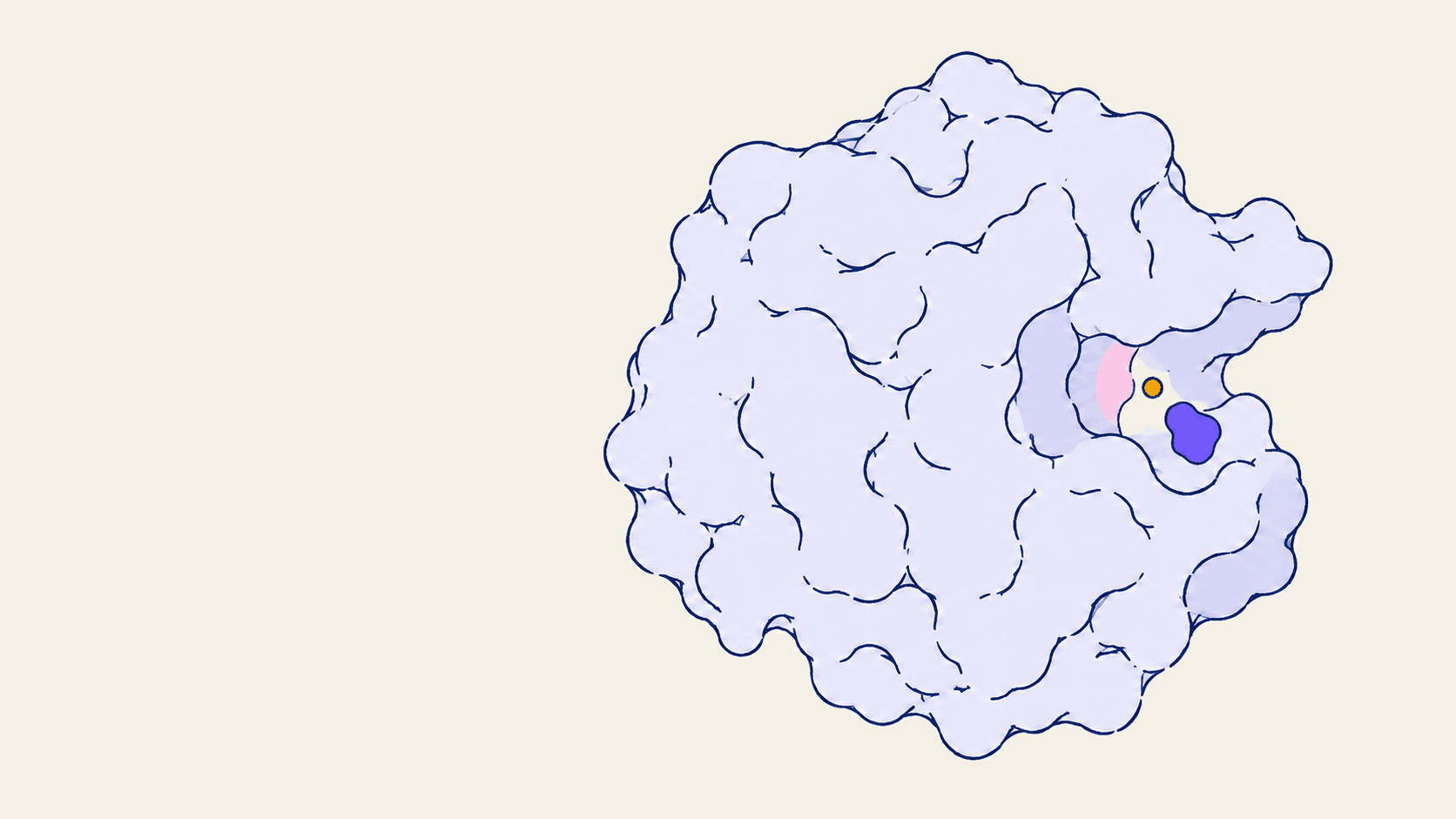
Conceptual illustration
Geometry earns an activity test
Positioning a substrate makes a catalytic hypothesis inspectable. This generic pocket sketch represents no published enzyme or measured reaction.
The assay reduced 190 designs to 35 multi-turnover enzymes
The authors prospectively screened 190 designs against an activated ester substrate. Thirty-five showed multiple turnovers. The most active reported design reached a catalytic efficiency of 3,557 M⁻¹ s⁻¹.
Most screened designs did not meet the multi-turnover bar. A program therefore needs both a credible structural shortlist and enough assay capacity to learn from the failures.
The reported hit rate belongs to this reaction, motif, pipeline, and screen. It does not establish a general success rate for enzyme design, another substrate, or a development program with different expression, selectivity, stability, or manufacturing requirements.
| Stage | Evidence in the published example | Decision for an enzyme program |
|---|---|---|
| Structural walkthrough | An author-released tutorial output illustrates the catalytic design concept. | Use it to understand the method; it has no demonstrated activity in this story. |
| Experimental screen | 190 designs tested; 35 showed multiple turnovers on the reported substrate. | Plan experimental capacity around attrition, with the denominator kept visible. |
| Best reported activity | Catalytic efficiency of 3,557 M⁻¹ s⁻¹ in the published assay. | Check activity on the intended substrate and under the conditions the application requires. |
| Application fit | Process performance is outside this demonstration. | Stability, selectivity, expression and production requirements belong in the next evidence package. |
From an assay hit to a process enzyme
The next brief should start with the intended application: the substrate that matters, the conditions the enzyme must tolerate, and the activity that would justify further development. That gives a measured hit a clear next question instead of treating the screen as the finish line.
For a Crane study, we would agree those criteria with the experimental team before choosing a design panel. The useful outcome is a set of candidates with a stated reason to test each one and a plan for interpreting the measurements, including designs that miss the bar.
What must your enzyme do in practice?
Bring the reaction, substrate, and operating conditions that matter. We can scope a design study around measurable activity and a candidate panel your laboratory can evaluate.
Part 4 of 7
Protein AI field guide
Protein AI in practice: a seven-part field guide
Seven connected decisions, illustrated by different molecular systems and published studies. Frame the problem and choose a route, specify the physical constraints, then decide what evidence earns the next experiment.
Start with the decision in front of you. After choosing a state, follow the binding-site or catalytic-chemistry example that fits your application. Article numbers follow publication order.
- 01
Frame the problem
Available now
Map the Molecular System
Before models run, map the constructs, partners, ligands, stoichiometry, and interfaces that carry the biology.
- 05
Available now
One Target, Three Development Strategies
Proteins, peptides, nucleic acids, and small molecules offer different routes to the same goal.
- 02
Specify the design
Available now
The Target Changes Shape
Compare measured target states before choosing a structural reference.
- 03
Available now
Choose the Site Before the Binder
For binding programs: connect the chosen surface to the intended biological effect.
- 04
Current story4 of 7
Design the Chemistry Before the Scaffold
For enzyme programs: distinguish a catalytic geometry from measured activity.
- 06
Decide what advances
Available now
When a Binder Earns the Next Experiment
Separate measured binding, solution behavior, and structural agreement from open development questions.
- 07
Learn from measurement
Available now
The Next Round Starts with the Assay
Build, test, learn, and feed experimental results into the next design round.