Protein AI field guideArticle 6 of 7
When a Binder Earns the Next Experiment
The published BindCraft Der f 7 campaign tested binding, solution behavior, and structural agreement. Together, those measurements explain why a promising binder deserves further work, while leaving development readiness an open question.
- Evidence type
- Published-study walkthrough
- Published
- September 2026
Generation creates options. Gates allocate resources.
The highest-affinity binder is not automatically the best molecule to advance. Poor solution behavior, an unsuitable format, or a missing biological effect can change the decision. A useful shortlist shows which questions have been answered and which still carry the risk.
The published Der f 7 example makes three kinds of evidence visible: binding, behavior in solution, and agreement with a measured structure. These are complementary observations, not a universally ordered sequence of independent gates. The application determines which tests matter and when to run them.
Different measurements, different questions
Loading released Der f 7 structures
computed selection
Build a deep, diverse candidate pool
The published workflow recommends generating until at least 100 designs pass confidence, interface, geometry, and physics-based filters, then selecting a small, diverse experimental panel.
Evidence boundary
Computational filtering prioritizes plausible candidates. It does not measure affinity, expression, oligomeric state, specificity, or function.
Published BindCraft selection protocol
Ten designs entered the assay. Four bound.
The peer-reviewed BindCraft study evaluated designs against 12 targets. For the dust mite allergen Der f 7, the authors tested 10 designs and detected four binders by surface plasmon resonance. Binder2 was the strongest, with a reported Kd of 12.8 nM.
That result is encouraging precisely because it includes attrition. The computational workflow narrowed the search, but it did not make every filtered design a binder. Across all 12 reported targets, experimental success ranged from 10 to 100 percent, with a reported average of 46.3 percent. Those rates belong to the study's targets, constructs, filters, and assays.
The denominator matters: these ten molecules had already survived computational selection. Four out of ten describes the tested panel, not every generated design. For planning purposes, a team needs to keep computational attrition and experimental attrition separate.
What solution and structural measurements added
Binding was only one step. SEC-MALS showed binder2 was monomeric in solution. Two crystal forms confirmed the complex. The 2.2 Å structure PDB 9HAE is displayed above. After aligning on Der f 7, the study reports a 1.7 Å binder backbone RMSD between the design model and measurement.
The authors' released design models provide the planned complex, while the crystal structure provides an independent physical reference. The BindCraft implementation also exposes the confidence, interface, clash, hydrophobicity, unsatisfied hydrogen bond, and monomer-fold metrics used for computational triage.
The result does not automatically make binder2 a therapeutic candidate. Immunogenicity, stability under the intended conditions, delivery, exposure, specificity in the relevant biological matrix, formulation, and manufacturing still sit beyond this evidence package.
| Evidence | Published observation | Decision it can inform |
|---|---|---|
| Binding | Binder2 Kd 12.8 nM by SPR. | Prioritize a measured hit for further characterization under the intended conditions. |
| Solution behavior | SEC-MALS supported a monomeric binder2. | Reduce concern about oligomerization under those measurement conditions. |
| Structural agreement | Two crystal forms; reported binder backbone RMSD of 1.7 Å after target alignment. | Assess whether the designed interface was physically realized. |
| Development readiness | Program-specific function, specificity, stability and delivery remain to be established. | Choose the next tests from the intended application rather than declaring a therapeutic candidate. |
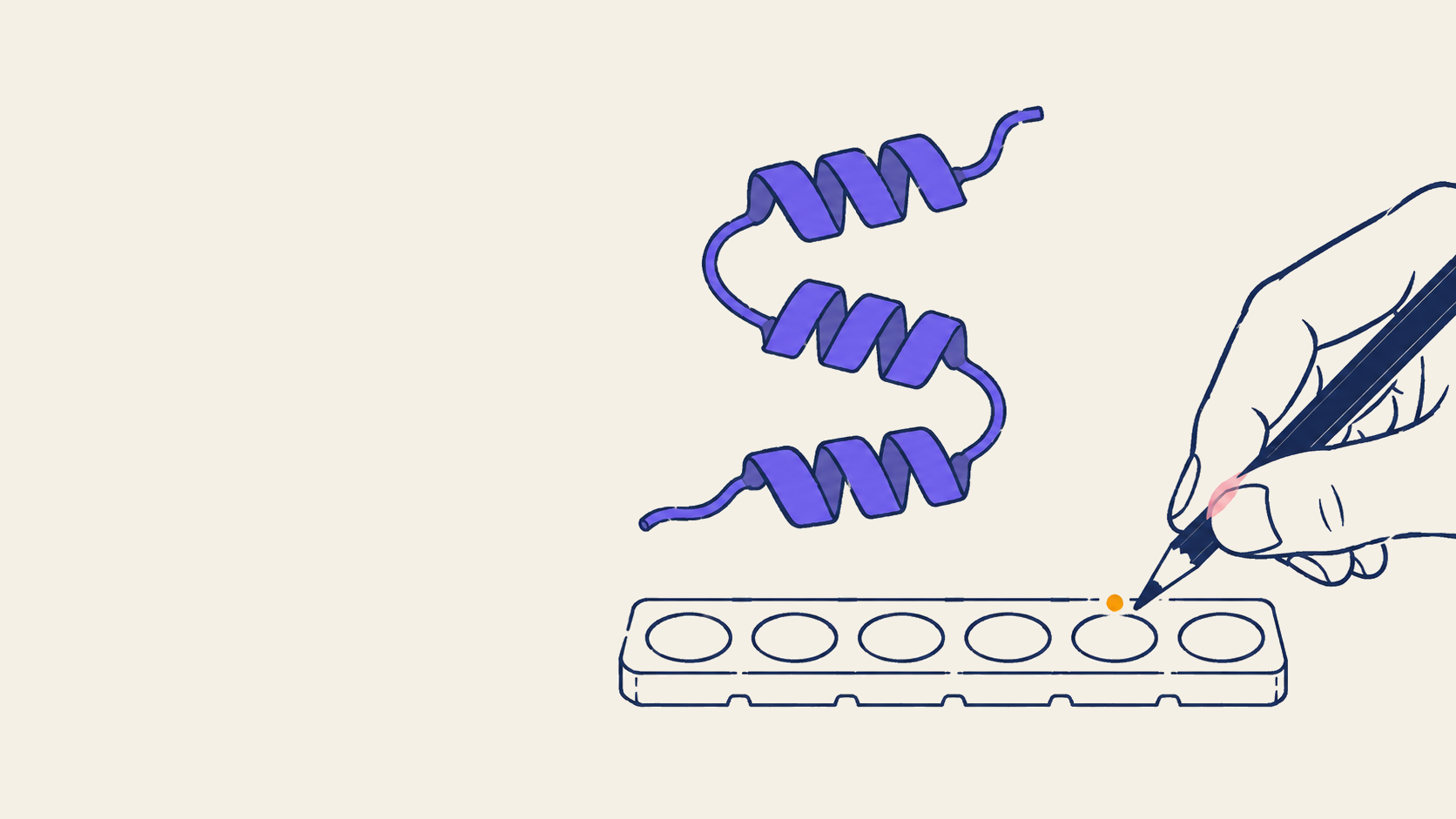
Conceptual illustration
Give every candidate a reason to advance
An empty assay well represents an unanswered question. The next experiment should resolve a reason to advance, revise, or stop.
How we would scope a candidate review
For a Crane candidate review, we would agree the decision criteria with the team, choose complementary methods, and investigate where they disagree. We would preserve useful diversity in the panel and identify which remaining uncertainty each proposed experiment addresses.
Two similarly ranked candidates may need different next steps. One may lack a convincing solution-behavior measurement; another may bind well but leave the intended biological effect unresolved. A useful review makes that distinction visible.
The deliverable is a compact candidate panel with a traceable reason for each inclusion, the unresolved risk, and a proposed next measurement. That process is the service we would scope; the Der f 7 results above belong to the published BindCraft study.
Once those measurements arrive, they should change the next selection. The final article follows that return from assay evidence to a design decision.
Which candidates deserve your next assay?
Bring your sequences, current rankings, and measured results. We can assess the evidence behind the shortlist and help define a compact panel with a clear reason for every inclusion and next experiment.
Part 6 of 7
Protein AI field guide
Protein AI in practice: a seven-part field guide
Seven connected decisions, illustrated by different molecular systems and published studies. Frame the problem and choose a route, specify the physical constraints, then decide what evidence earns the next experiment.
Start with the decision in front of you. After choosing a state, follow the binding-site or catalytic-chemistry example that fits your application. Article numbers follow publication order.
- 01
Frame the problem
Available now
Map the Molecular System
Before models run, map the constructs, partners, ligands, stoichiometry, and interfaces that carry the biology.
- 05
Available now
One Target, Three Development Strategies
Proteins, peptides, nucleic acids, and small molecules offer different routes to the same goal.
- 02
Specify the design
Available now
The Target Changes Shape
Compare measured target states before choosing a structural reference.
- 03
Available now
Choose the Site Before the Binder
For binding programs: connect the chosen surface to the intended biological effect.
- 04
Available now
Design the Chemistry Before the Scaffold
For enzyme programs: distinguish a catalytic geometry from measured activity.
- 06
Decide what advances
Current story6 of 7
When a Binder Earns the Next Experiment
Separate measured binding, solution behavior, and structural agreement from open development questions.
- 07
Learn from measurement
Available now
The Next Round Starts with the Assay
Build, test, learn, and feed experimental results into the next design round.