Finding Stabilizing Mutations in a Classic Lipase Benchmark
A structure-and-sequence-only first round recovered 13 of 20 published stabilizing positions in BsLipA; iterative retrospective calibration recovered 18 of 20.
- Evidence type
- Use Case
- Published
- March 2026
Your enzyme works in the lab. It dies in the reactor.
Higher temperatures can mean faster reactions, lower contamination risk, and broader process compatibility. But improving thermostability usually takes many rounds of design, expression, and screening. Directed evolution works. It is also slow, empirical, and lab-intensive.
We asked a narrower question: how far can a structure-guided proposal system get on a hard published benchmark before any wet-lab iteration, and how much further can it get once published outcomes are used to calibrate the search?
The benchmark: a deeply studied lipase with published outcome data
We chose Bacillus subtilis Lipase A (BsLipA) because the literature provides unusually deep experimental coverage. Published campaigns from Reetz, Rao, and Rathi collectively identify 20 stabilizing positions, and later mechanistic work by Augustyniak et al. shows why this is a demanding target: much of the observed benefit comes from reduced aggregation of unfolding intermediates rather than simple thermodynamic stabilization.
- Reetz's lab (Max Planck Institute) used B-FIT iterative saturation mutagenesis, targeting the most flexible positions in the crystal structure, then systematically combining hits. Their best combination of mutations achieved a +45°C improvement in T50 (60 min).*
- Rao's lab (CCMB Hyderabad) used classical directed evolution, random mutagenesis and recombination across six generations, accumulating 12 mutations that shifted the melting temperature from 56°C to 78°C.
- Rathi et al. computationally predicted and experimentally validated three more stabilizing mutations using rigidity theory, with the best single mutation contributing +6.6°C.
* T₅₀ (60 min) is the temperature at which 50% of initial enzyme activity remains after 60 minutes of incubation. Wild-type T₅₀ (60 min) ≈ 48°C; best combinatorial variant (5-7 mutations) reached ≈ 93°C. Their best single mutation contributed only +4.3°C: the +45°C cumulative gain is one of the largest thermostability improvements ever reported for any enzyme, and illustrates how individually modest mutations can compound when combined. (Reetz, Carballeira & Vogel, 2006; as quoted in Rathi et al. 2016: "Four more steps of optimization and screening of about 8000 colonies then yielded two variants carrying five and seven mutations that showed an increase of T₅₀ by 45°C.")
We evaluated BsLipA with two parallel processes. A proposal loop, running on the Crane Protein Intelligence Platform, saw only the crystal structure (PDB 1ISP, 1.30 Å resolution) and wild-type sequence and proposed ranked variant sets. In parallel, a verification loop had access to the published experimental outcomes and scored each proposal against the literature. Across iterative rounds, the verification loop identified which mutation classes were still being missed and updated the instructions for the next proposal round.
Round 1 was structure-and-sequence only. Later rounds were retrospective, outcome-guided calibration.
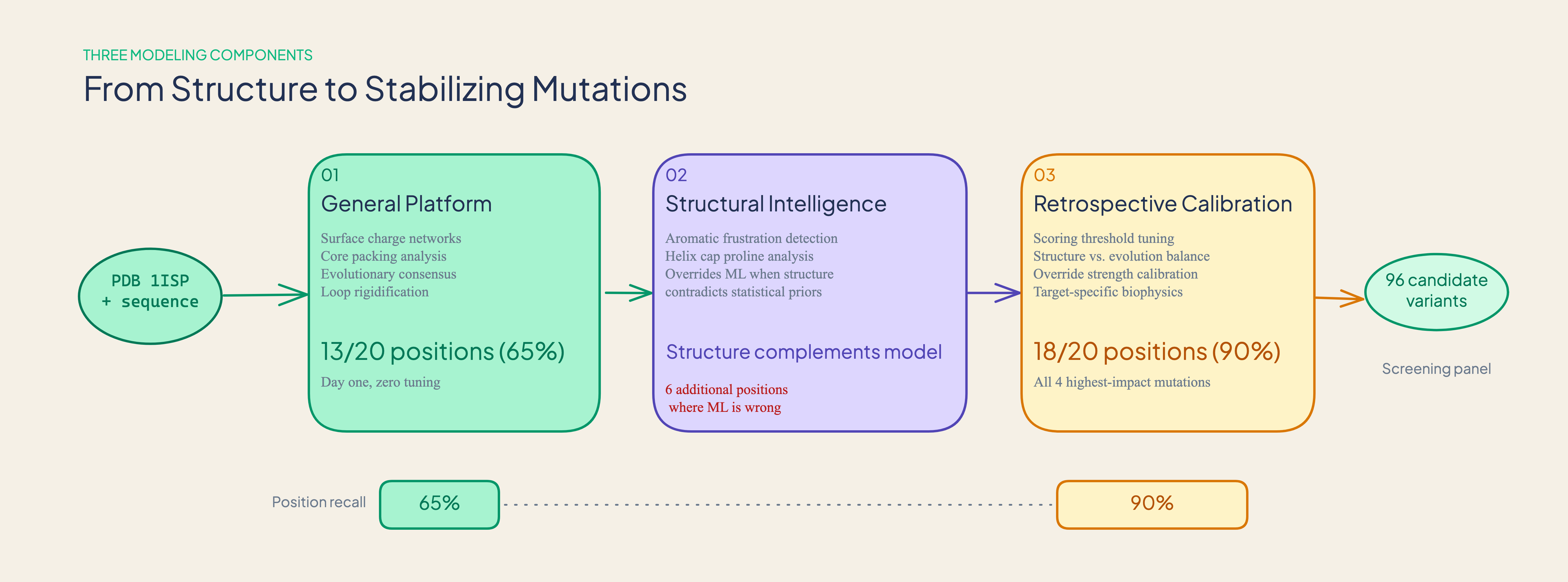
Round 1 baseline: what the general pipeline finds from structure and sequence alone
Before any target-specific optimization, the platform combines structure-based stability predictors, evolutionary models, and biophysical analysis into an integrated prediction pipeline. Two parallel tracks search for different classes of stabilizing mutations: surface engineering (charge networks, loop rigidification, consensus substitutions) and core optimization (cavity filling, packing quality, buried residue analysis).
In round 1, the general pipeline recovered 13 of the 20 published stabilizing positions (65%). At those recovered positions, 9 of the 13 matched the exact published amino acid (69%). One of the strongest single-point gains in the benchmark, M137P (+6.8°C in the published dataset), was ranked at the top from structural and biophysical reasoning alone.
This is the baseline. No target-specific tuning. No iteration. A protein engineer would leave round 1 with a shorter, mechanistically annotated shortlist to test.
But 65% isn't 90%. Seven positions are still missing. To find them, the analysis needs to go deeper.
Case study: when structural analysis overrode a negative sequence prior
Machine learning models for protein stability encode strong statistical priors from large training datasets. Most of the time, those priors are correct. But some stabilizing mutations violate the patterns that ML models have learned, and at those positions, the models are not just uncertain, they're confidently wrong.
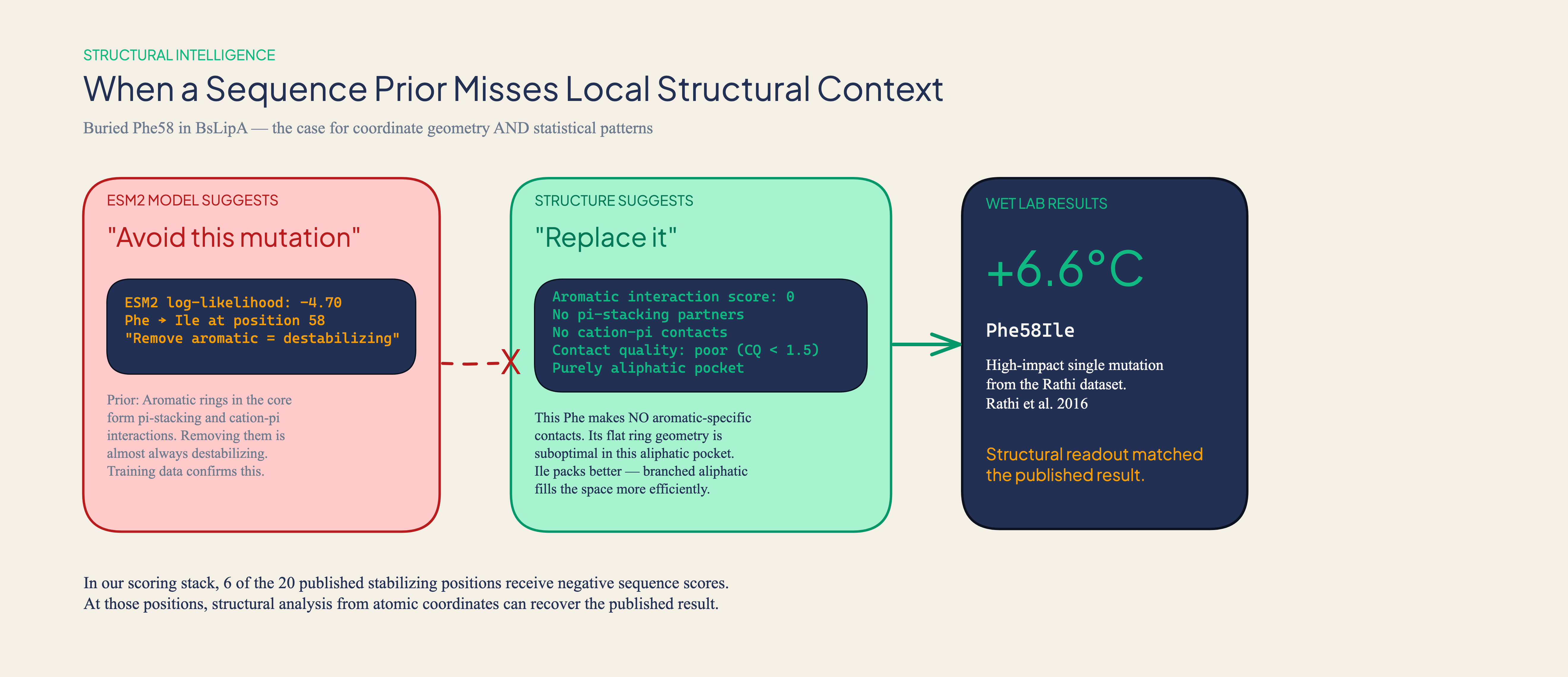
In our sequence-based scoring stack, 6 of the 20 published stabilizing positions receive negative model scores. A representative case is F58I, a high-impact single mutation reported at +6.6°C. ESM2 assigns F58I a strongly negative log-likelihood score (−4.70), indicating that the sequence model disfavors the substitution. The negative sequence prior misses a local structural context that helps explain the published result.
Consider this position, a buried phenylalanine. Sequence models encode a strong prior: removing an aromatic ring from the protein core is destabilizing. That's usually true. But this particular phenylalanine sits in a purely aliphatic pocket, making no aromatic-specific contacts. Its flat ring geometry is suboptimal. A branched aliphatic like isoleucine packs better, and the crystal structure coordinates show this directly.
The platform detects these cases from the atomic coordinates alone. For each buried aromatic, the pipeline computes whether it participates in aromatic-specific interactions and how well it packs against its neighbors. Where the structure shows a frustrated aromatic with poor contacts, the sequence prior is overridden. This specific override does not depend on labeled outcomes; it depends on local geometry and well-established biophysics.
This is where the pipeline earns its keep. Running a sequence model is straightforward. The harder problem is knowing when to override it, and having the structural reasoning to do so defensibly.
Outcome-guided retrospective calibration on BsLipA
Across repeated retrospective proposal-verification cycles, the verification loop used the published outcomes to identify which mechanistic classes were still being missed and to tune the proposal instructions to match: how much weight to give structural evidence versus evolutionary conservation, when to override negative sequence priors, and how strongly to prioritize motif-level rules such as helix-cap prolines.
By the final round, the calibrated system recovered 18 of 20 published stabilizing positions (90%). Eleven final calls matched the exact published amino acid, and seven more landed on the correct position with a different substitution. All four highest-impact published mutations were recovered. In other words, the final tally was 11 exact published amino acid matches, 7 same-position alternate substitutions, and 2 misses.
Because these later rounds used published outcomes for calibration, this should be read as a retrospective result on BsLipA rather than a prospective validation on a fresh target.
Positions recovered, round 1
13/20 (65%)
Positions recovered, final round
18/20 (90%)
Exact published amino acid matches
11
Same-position alternate substitutions
7
Misses
2
Highest-impact mutations
4/4 recovered
Candidate variants in final panel
96 variants
The two remaining misses cluster in interaction types not yet captured by the workflow, including electrostatic decomposition and hydrogen-bond network analysis. That gives us a concrete picture of what the current stack still under-models.
Mutation-by-mutation results
To make the benchmark auditable, the full set of 20 published stabilizing positions is listed below with the reported substitution, reported effect size where available, and the final prediction outcome.
The gold category (correct position, different amino acid) still points to the right site, but is not counted as an exact published match.
| Pos | Published stabilizing substitution(s) | Effect | Source | Our result |
|---|---|---|---|---|
| 15 | A15S | cumulative | Rao | Exact match |
| 17 | F17S | cumulative | Rao | Exact match |
| 20 | A20E | cumulative | Rao | Exact match |
| 33 | R33G/Q | combinatorial | Reetz | Position found, different AA |
| 34 | D34N | combinatorial | Reetz | Exact match |
| 35 | K35D | combinatorial | Reetz | Position found, different AA |
| 54 | V54H | +5.7°C | Rathi | Position found, different AA |
| 58 | F58I | +6.6°C | Rathi | Exact match |
| 89 | N89Y | cumulative | Rao | Exact match |
| 96 | V96S | +3.6°C | Rathi | Miss |
| 111 | G111D | cumulative | Rao | Miss |
| 112 | K112D | combinatorial | Reetz | Position found, different AA |
| 114 | L114P | +1.0-1.9°C | Rao | Exact match |
| 132 | A132D | +1.0-1.9°C | Rao | Exact match |
| 134 | M134D/E | +5.8°C | Reetz + Rao | Position found, different AA |
| 137 | M137P | +6.8°C | Rao | Exact match |
| 139 | Y139C | combinatorial | Reetz | Position found, different AA |
| 157 | I157M | convergent | Reetz + Rao | Position found, different AA |
| 163 | S163P | +1.8°C | Rao | Exact match |
| 166 | N166Y | cumulative | Rao | Exact match |
Single-mutation temperature shifts are shown where available. Entries labeled cumulative, combinatorial, or convergent come from multi-mutation backgrounds and are not directly comparable numerically.
What this tells us
BsLipA does not prove prospective performance on every enzyme. It does show something narrower and useful: structure-guided rules can recover a meaningful share of known stabilizing positions on a hard target from day one, and a feedback loop can materially improve coverage once labeled data exists.
The specific mutations are BsLipA-specific. The more transferable part is the mechanistic vocabulary: surface charge engineering, core packing, helix-boundary rigidification, and context-dependent overrides of sequence priors.
For a new enzyme, the right expectation is not "90% on day one." The right expectation is a mechanistically reasoned starting panel, and a system that can learn quickly from screening results.
The practical output
The practical output is a 96-variant screening panel. Each candidate comes with a mechanistic rationale, a confidence rank, and an activity-risk annotation.
These are testable hypotheses for synthesis and screening, not validated wins. The value is not only the shortlist; it is the traceable reasoning behind each call and the ability to update the shortlist as data comes back.
What would change?
What would change if you could start with a smaller, mechanistically ranked panel instead of screening thousands of variants blind, and improve that panel quickly as feedback comes back?
If you're working on a thermostability problem, we'd be happy to show how this workflow would look on your enzyme.
References and benchmark notes
This benchmark aggregates published BsLipA thermostability data from Reetz, Rao, Rathi, and Augustyniak et al., uses PDB 1ISP as the structural starting point, and reports round 1 separately from the final calibrated result to distinguish structure-only proposals from outcome-guided retrospective calibration. It is a site-level benchmark assembled from both single-mutation and multi-mutation BsLipA studies.
- Reetz, Carballeira & Vogel, Angew. Chem. Int. Ed. 2006, 45, 7745-7751.
- Gumulya & Reetz, ChemBioChem 2011, 12, 2502-2510.
- Acharya et al., J. Mol. Biol. 2004, 341, 1271-1281.
- Ahmad, Kamal et al., J. Mol. Biol. 2008, 381, 324-340.
- Rathi, Fulton, Jaeger & Gohlke, PLoS Comput. Biol. 2016, 12, e1004754.
- Augustyniak et al., Protein Sci. 2012, 21, 487-497.
- van Pouderoyen et al., J. Mol. Biol. 2001, 309, 215-226. (PDB 1ISP)