Finding a Cyclic Peptide at the Right PD-L1 Address
We generated 11 independent cyclic-peptide designs on Crane and selected three computational leads. The published p104 complex provides an independent measured-affinity and 5 Å contact reference for later evaluation.
- Evidence type
- Use Case
- Published
- July 2026
Seven closed rings, one geometric lead
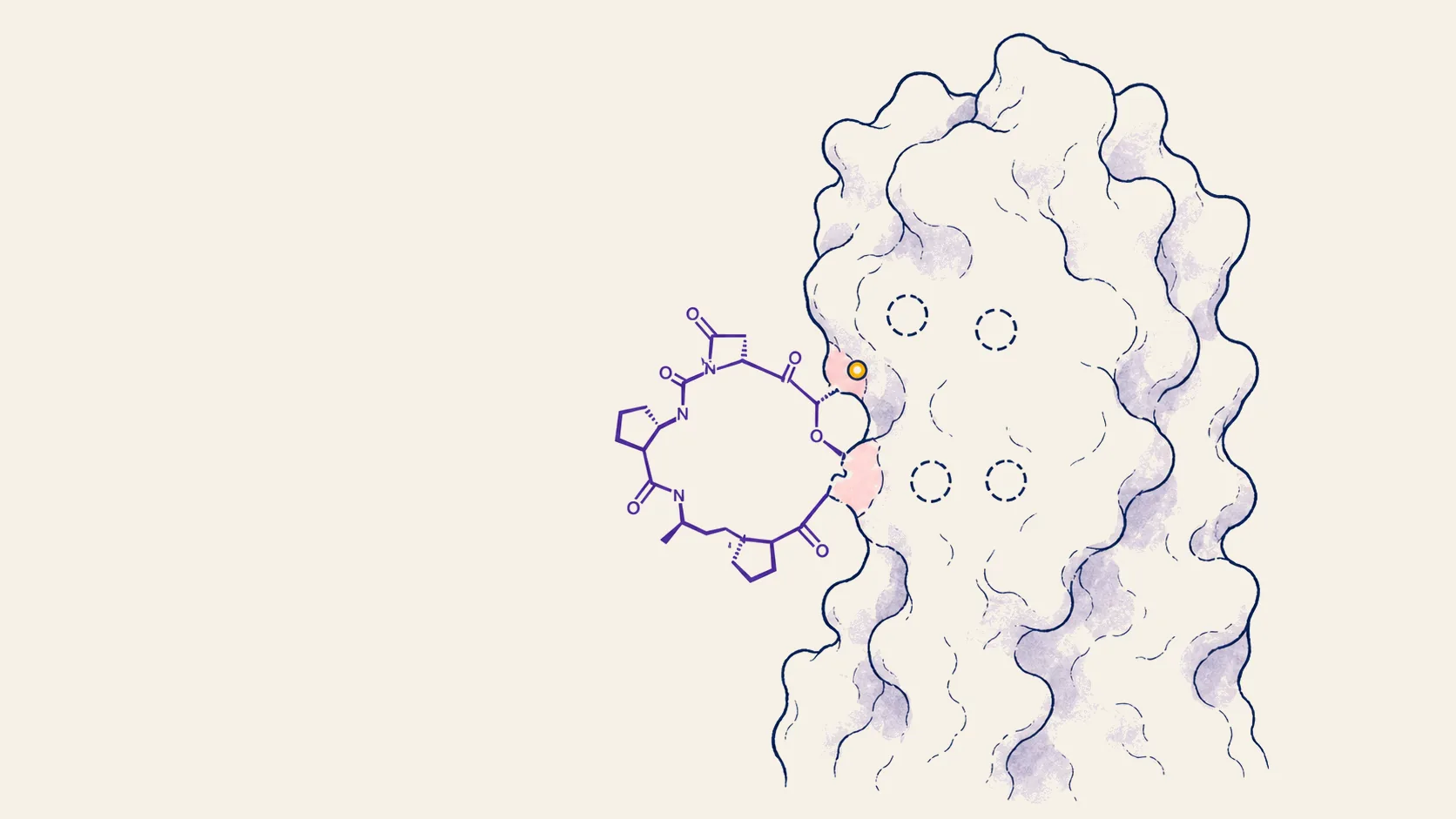
We generated 11 independent cyclic-peptide designs on Crane against a defined PD-L1 surface. Seven formed credible closed rings. Seed 51 was the only valid cycle to reach two of the four requested PD-L1 positions, making it the strongest geometric lead in this campaign.
The top three move into full-atom design and independent complex prediction. None is ready for synthesis yet: the current structures establish backbone geometry, not binding affinity.
- Designs generated
- 11
- Closed cycles
- 7
- Lead geometry
- Seed 51
The design brief
PD-L1 suppresses immune activation by engaging PD-1. The campaign asked whether a compact, head-to-tail cyclic peptide could be placed against a chosen PD-L1 surface near residues B64, B68, B126, and B128. Those four positions define the requested molecular address.
State-of-the-art open-source cyclic-peptide design tools deployed on Crane generated one candidate from each of seeds 42 through 52. Every candidate received the same target structure, requested residues, and cyclic-closure constraint, so the resulting geometries could be compared through one ordered screen.
- Gate 1Confirm ring closureKeep a head-to-tail C-N distance of 1.20-1.50 Å.
- Gate 2Reach the addressRank valid cycles by requested residues reached within 5 Å.
- Gate 3Break geometric tiesUse peptide-target atom pairs below 5 Å as a secondary measure.
What the 11 designs showed
The campaign produced a useful spread rather than eleven versions of the same answer. Seven candidates passed the non-negotiable closure gate; four designs failed the closure gate and were rejected even when they showed close target proximity. Among valid cycles, hotspot coverage separated the leaders from the rest.
| Seed | Sequence | Closure | Address | Pairs <5 Å | Decision |
|---|---|---|---|---|---|
| 51 | FDLLSNSALDQNA | 1.340 Å | 2/4 | 104 | Advance |
| 43 | GGPEVASANFVS | 1.319 Å | 1/4 | 61 | Advance |
| 48 | GLSCFSVM | 1.356 Å | 1/4 | 50 | Advance |
| 47 | NAGSRFSSQVKNLMP | 1.326 Å | 1/4 | 44 | Review |
| 44 | SHFPTSKKETF | 1.343 Å | 1/4 | 36 | Review |
| 46 | VKPEGTHPMGYYR | 1.357 Å | 0/4 | 42 | Review |
| 42 | WCSPTLKKTYPQCH | 1.331 Å | 0/4 | 40 | Review |
| 52 | IKERGTMTRKQSLMSVKER | 1.720 Å | 1/4 | 76 | Reject |
| 50 | MTKWLIRSKLDTTAVNYLQPMSDE | 2.224 Å | 1/4 | 51 | Reject |
| 45 | ISFIIASILCGQNEKPPAG | 1.663 Å | 1/4 | 46 | Reject |
| 49 | RADIVSTECHSANAQQRR | 1.687 Å | 0/4 | 77 | Reject |
This order matters. Seed 52, for example, has 76 close atom pairs, but its 1.720 Å closure misses the ring-geometry requirement. Interface counts cannot rescue a structure that fails its primary constraint.
Why Seed 51 leads
Seed 51 is a 13-residue backbone with a 1.340 Å closure. It approaches B64 at 4.93 Å and B126 at 3.96 Å, while B68 and B128 remain 9.26 Å and 12.86 Å away. Its sequence and the other ten campaign outcomes are reported in the table above. Its 104 peptide-target pairs below 5 Å and 2.96 Å closest contact give it the strongest combined geometry in the set.
That result supports advancement, not a binding claim. Each requested residue is reached by only one atom pair, the peptide has backbone atoms but no designed sidechains, and no independent complex prediction has yet tested whether the pose is stable.
Seed 51 lead geometry
Drag to rotate · Scroll to zoom
What a proven PD-L1 cyclic peptide looks like
p104 is included for one narrow purpose: to show the measured affinity and atomic contact footprint of a cyclic peptide proven to bind PD-L1. Its published complex, PDB 7OUN, combines a 1.9 Å crystal structure with a measured 380 nM affinity and a 15.2 ± 2.7 µM cellular EC50.
Measured affinity
380 nM
5 Å footprint
13 residues
Close atom pairs
264
The crystal complex contains 13 PD-L1 residues within 5 Å of p104: I54, Y56, E58, Q66, V68, V76, R113, M115, S117, A121, D122, Y123, and K124. Together they contribute 264 full-atom pairs below 5 Å.
How to use the reference
p104 is an independent comparator. It is not used to validate or rank the generated candidates against the four requested residues. Its measured affinity and contact footprint provide a reference for interpreting later affinity projections and full-atom interfaces; they do not imply potency for the current backbone designs.
p104: measured reference
Drag to rotate · Scroll to zoom
What moves forward
Seeds 51, 43, and 48 move into full-atom sidechain design and independent PD-L1 complex prediction. The next gate asks whether each peptide retains its pose, develops specific polar and hydrophobic packing, and buries a credible peptide-protein interface.
Only candidates that survive those checks should approach synthesis. No binding has been measured for the generated designs. p104 provides context for later affinity projections and full-atom interfaces; it does not imply that any candidate shares its potency.
Sources
Experimental p104 measurements are reported in the published study. The co-crystal coordinates are available as PDB 7OUN.