Does Your Designed Protein Actually Stay Folded?
Molecular dynamics can add an important validation layer in protein engineering. We're adding it to the Crane Protein Intelligence Platform, starting with a fully automated GROMACS pipeline and a first benchmark that shows the approach works end-to-end.
- Evidence type
- Use Case
- Published
- March 2026
Every protein design pipeline ends with a prediction: a 3D model, a confidence score, a celebration. The backbone looks great. The side chains pack tightly. The metrics say this will fold.
But there's a gap between "predicted to fold" and "stays folded in explicit solvent under defined simulation conditions." That gap is where many design failures emerge. Closing it requires a different kind of computation, one rooted not in pattern matching but in physics.
The problem with snapshots
Structure predictors produce a single static image, the lowest-energy shape in a vacuum, with no water, no heat, no time. Real proteins are not static objects. They breathe, flex, and fluctuate on timescales from picoseconds to milliseconds. A protein that looks perfectly folded in a static model may still show instability once simulated in explicit solvent over time.
This is not a theoretical concern. The field of de novo protein design has long struggled with designs that look great on screen but fail in the lab; they don't express, they aggregate, or they lose activity under operating conditions. In many of these cases the predicted structure looked fine. The dynamics told a different story.
Molecular dynamics: the physics-based stress test
Molecular dynamics (MD) simulation takes a protein structure, places it in a box of explicit water molecules at a defined temperature and pressure, and integrates Newton's equations of motion forward in time. Every atom (protein, water, ions) moves according to the forces acting on it.
After millions of timesteps, you have a trajectory: a movie of the protein's motion under realistic conditions. Two commonly tracked metrics provide an initial read. RMSD measures how far the backbone drifts from its starting structure, the magnitude depends on protein size, fold class, and simulation context, but sustained low values suggest a maintained fold. Radius of gyration tracks compactness: a rising Rg suggests the protein is expanding and losing its tertiary structure.
These are starting points, not the full picture. A comprehensive dynamic assessment also considers per-residue flexibility, secondary structure persistence, hydrogen bond retention, and solvent-accessible surface area. But RMSD and Rg provide an initial dynamic signal: trajectory-derived indicators of backbone drift, compactness, and structural persistence under defined simulation conditions. Is the designed structure holding together, or is it drifting?
Why MD is hard, and why it matters
MD is conceptually straightforward but operationally complex. An eight-step pipeline takes a raw PDB file through structure preparation, force field assignment, solvation, charge neutralization, energy minimization, two phases of equilibration, and finally production simulation, before the actual analysis begins. Each step has parameters that must be chosen correctly. Each step can fail silently if configured wrong.
This complexity is why MD remains underused in protein design pipelines, despite providing an orthogonal validation signal that static predictors cannot. Teams that can run structure prediction and inverse folding often lack the expertise or infrastructure to set up, run, and interpret MD simulations. The result: designed proteins go straight from in silico prediction to wet lab, without the one computational step that tests dynamic behavior under explicit-solvent conditions.
Where MD fits in the design pipeline
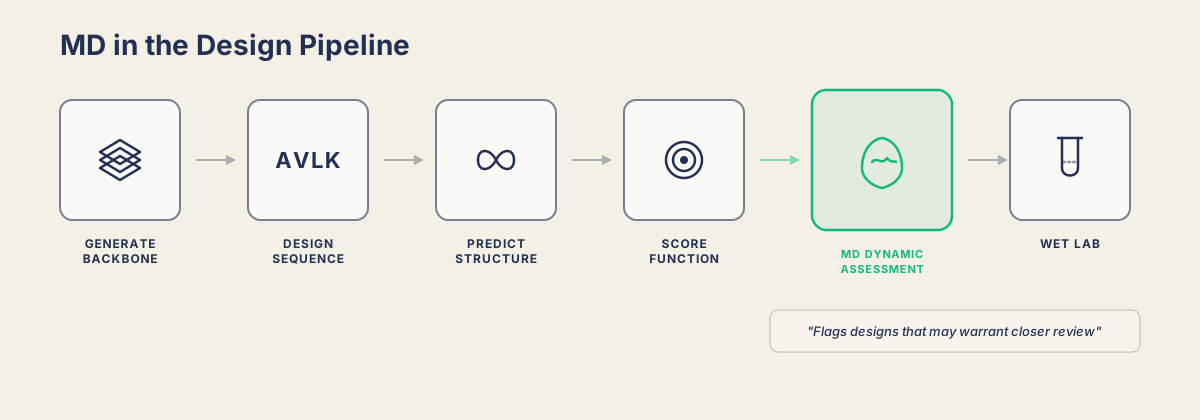
MD is a screening layer, not a design tool. It doesn't tell you how to fix a protein; it flags whether a design warrants closer review before committing to the lab. In a typical campaign, MD occupies the final computational step:
- Generate backbone: novel fold topologies
- Design sequence: optimized amino acid sequences
- Predict structure: verify the design folds as intended
- Score binding / function: interface quality
- MD dynamic assessment: does the fold remain structurally robust under simulation?
- Experimental validation: the wet lab
You only run MD on the 5-10 top candidates that have already passed every cheaper filter. It's the most expensive computational step, but it's orders of magnitude cheaper than discovering instability in the lab.
Our first steps: a fully automated pipeline
We've built and benchmarked the first version of a GROMACS-based MD pipeline for the Crane Protein Intelligence Platform. The pipeline takes a PDB file as input and returns an MD-based dynamic assessment (structure preparation, topology generation, solvation, ion addition, energy minimization, NVT (constant volume/temperature) and NPT (constant pressure/temperature) equilibration, production MD, and trajectory analysis) all within our platform with minimal hands-on time, supervised by real human protein engineers.
The validation ran on a 15-residue villin headpiece fragment, one of the most studied proteins in MD, chosen specifically because published benchmarks exist for comparison. The short-timescale RMSD and compactness behavior observed here is directionally consistent with prior villin headpiece results in explicit-solvent MD. The system comprised 25,410 atoms: 257 protein atoms, 8,368 water molecules, and 49 sodium/chloride ions at near-physiological ionic strength (0.15 M).
Validation results
Energy minimization converged in 939 steps, under 2% of the allowed budget, indicating a clean starting structure with no steric clashes. NVT and NPT equilibration each ran for 100 picoseconds (50,000 steps), bringing temperature and pressure to steady state at 300 K.
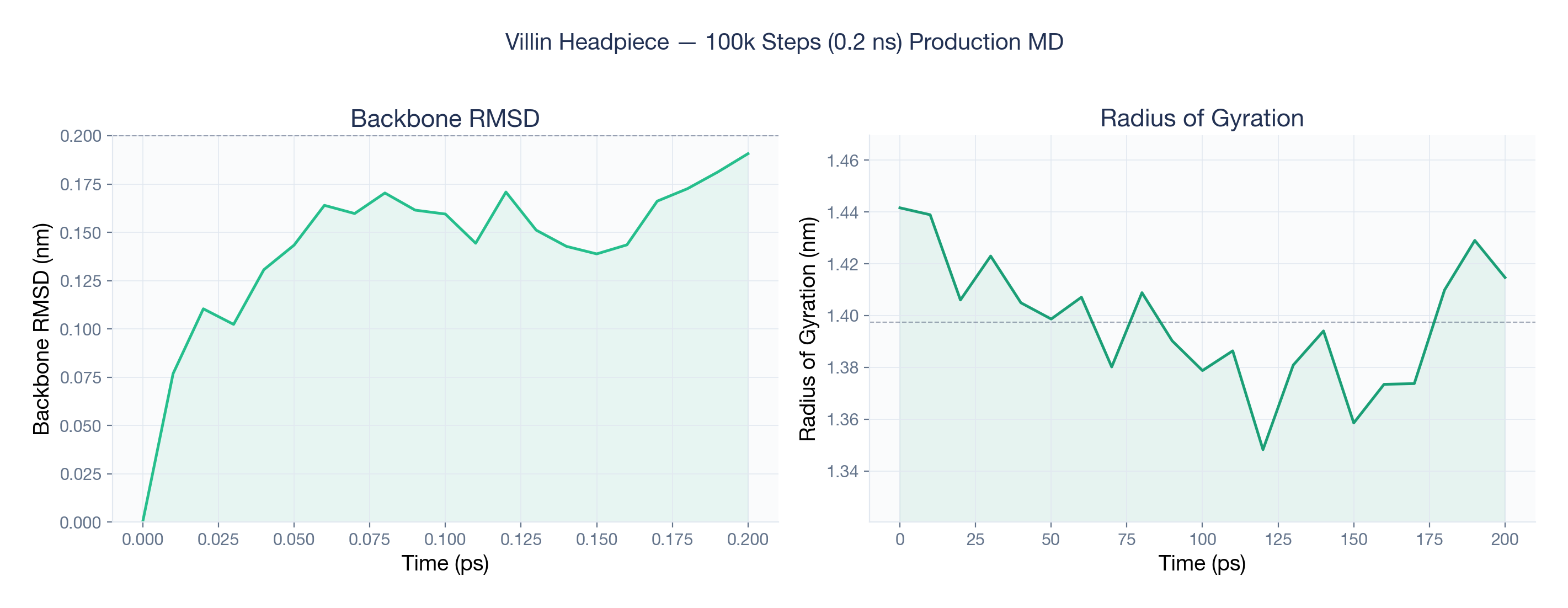
The production trajectory (100,000 steps, 0.2 ns) showed behavior consistent with a maintained fold. Backbone RMSD rose quickly from near-zero to ~0.11 nm in the first 20 picoseconds as the protein relaxed from its crystal packing, then plateaued in the 0.14-0.19 nm range for the remainder of the simulation, values consistent with short-timescale structural stability for a protein of this size and fold class. Radius of gyration held steady between 1.35 and 1.44 nm (mean 1.40 nm), suggesting the protein maintained its compact fold throughout.
System size
25,410 atoms
Energy minimization
939 steps (converged at <2% budget)
Equilibration
NVT + NPT, 200 picoseconds total, 300 K, 1 bar
Production MD
100k steps (0.2 ns), backbone RMSD 0.14-0.19 nm
Radius of gyration
Mean 1.40 nm (range 1.35-1.44 nm), compact fold maintained
Performance
~4.3 ns/day (CPU baseline)
Pipeline stages
8 (fully automated, end-to-end)
0.2 ns validates the pipeline automation and provides an initial dynamic signal. Production assessments for design campaigns will target longer trajectories, multiple replicates, and more metrics. This run shows the automation works end-to-end: PDB in, trajectory analysis out, no manual intervention required.
AI and MD: navigating complexity together
Here is the deeper point. MD simulation is one of the most powerful tools in structural biology, and one of the least accessible. The eight-step pipeline, the force field selection, the parameter tuning, the interpretation of RMSD plots and Rg trajectories, all of this requires specialized expertise that sits outside most protein engineering teams.
This is exactly the kind of terrain that becomes navigable in collaboration with AI. The platform helps navigate the standard setup and analysis under predefined protocols, reducing the mechanical complexity so the researcher can focus on interpreting results and making design decisions.
The goal is not to replace MD expertise: force field selection, protonation states, and simulation design still require domain knowledge. It's to lower the barrier so that more protein engineers can run a first dynamic assessment on their candidates, the same way the Crane Protein Intelligence Platform already makes structure prediction and binding analysis accessible through conversation.
What this validates, and what it doesn't
To be clear about where we are: this work validates that we can run a standard MD simulation in our customer campaigns, and that it recovers expected behavior on a canonical benchmark system. That's Claim A.
What it does not yet show is predictive power for designed proteins in real campaigns. That requires known stable and unstable controls, replicate trajectories across independent seeds, more metrics beyond RMSD and Rg (RMSF, secondary structure persistence, hydrogen bond retention), and, most importantly, retrospective correlation with experimental outcomes like expression, SEC behavior, or thermal stability measurements.
We're building toward that validation deliberately, not claiming it prematurely.
What comes next
This CPU-based MVP is a deliberate baseline: for a 15-residue fragment, GPU acceleration isn't necessary and would add complexity without insight. The next steps are about expanding scope: longer trajectories with multiple replicates, per-residue flexibility analysis (RMSF), expanded metrics, and benchmarking across diverse protein classes, not just small well-behaved folds. GPU acceleration becomes relevant when we move to larger systems where CPU runtimes become the bottleneck.
Equally important is building the biological validation layer: running the pipeline on proteins with known experimental outcomes to establish where the dynamic signal correlates with wet-lab reality and where it doesn't.
Static structures are hypotheses. Dynamics provides an orthogonal test of structural robustness. We're building the infrastructure to make that test accessible to every protein design campaign that runs through the platform.
These are first steps on the trail. We're looking forward to the rest of the hike.
What if your best designs aren't as stable as you think?
Most protein engineering teams go straight from prediction to the wet lab. What would change if you could see how your candidates behave under realistic conditions before committing to synthesis?
We'd love to explore that question with you.