Educated Calls on Homo-Oligomerization With Cross-Tool Consensus
Sometimes sequence is all you have, and the question 'does this protein form a homo-oligomer?' sits in front of every wet-lab decision after it. We ran 20 proteins (10 confirmed homo-oligomeric controls and 10 well-characterized monomeric controls) through Boltz-2 and IntelliFold v2-flash, swept candidate oligomeric states n=2..8, and asked one thing: do both tools agree? On this panel, cross-tool agreement separated true oligomeric signal from single-tool artifacts. Where one tool was confident on its own, we flagged it for orthogonal evidence rather than acted on it.
- Evidence type
- Use Case
- Published
- May 2026
How we make the call
Most of the time the question, does this protein form a homo-oligomer and at what stoichiometry, has to get answered before a team commits bench time. The point of this pilot was to check whether two MSA-aware co-folding tools, run in parallel across candidate oligomeric states n=2..8, give a usable first-pass call on it.
Setup. 20 proteins. 10 confirmed homo-oligomeric controls, 10 well-characterized monomeric controls. We ran Boltz-2 + MSA and IntelliFold v2-flash + MSA across candidate homo-oligomeric states n=2..8, with monomer (n=1) models generated as reference structures where useful. For each candidate oligomeric assembly we took the lower of the two ipTM values as the consensus score. That is the rule: the call needs both tools to agree.
We do not treat this as a universal oligomeric-state classifier. It is a practical first-pass workflow. When two separately implemented MSA-aware tools agree, the assembly moves up the queue for wet-lab follow-up. When only one is confident, the call stays a hypothesis until orthogonal evidence weighs in.
Evidence box
- Task: rank homo-oligomeric-state hypotheses from sequence, queue assemblies for wet-lab follow-up, flag where the two tools disagree
- Inputs: protein sequence only. Each tool builds its own MSA.
- Panel: 20 proteins. 10 confirmed homo-oligomeric controls + 10 well-characterized monomeric controls. Native n ∈ {1, 2, 4, 6, 7}. Sequence length 60 to 250 aa.
- Tools: Boltz-2 + MSA, IntelliFold v2-flash + MSA, run as separately implemented MSA-aware co-folding models. Consensus = lower of the two ipTM values per (protein, n).
- Benchmark: Lebedenko & Salinas (bioRxiv 2025), 35/40 correct on a 40-protein test with single-tool ipTM sweeps; Bertoline et al. (bioRxiv 2025), TPR 18% at 1% FPR for AF-Multimer on homodimers.
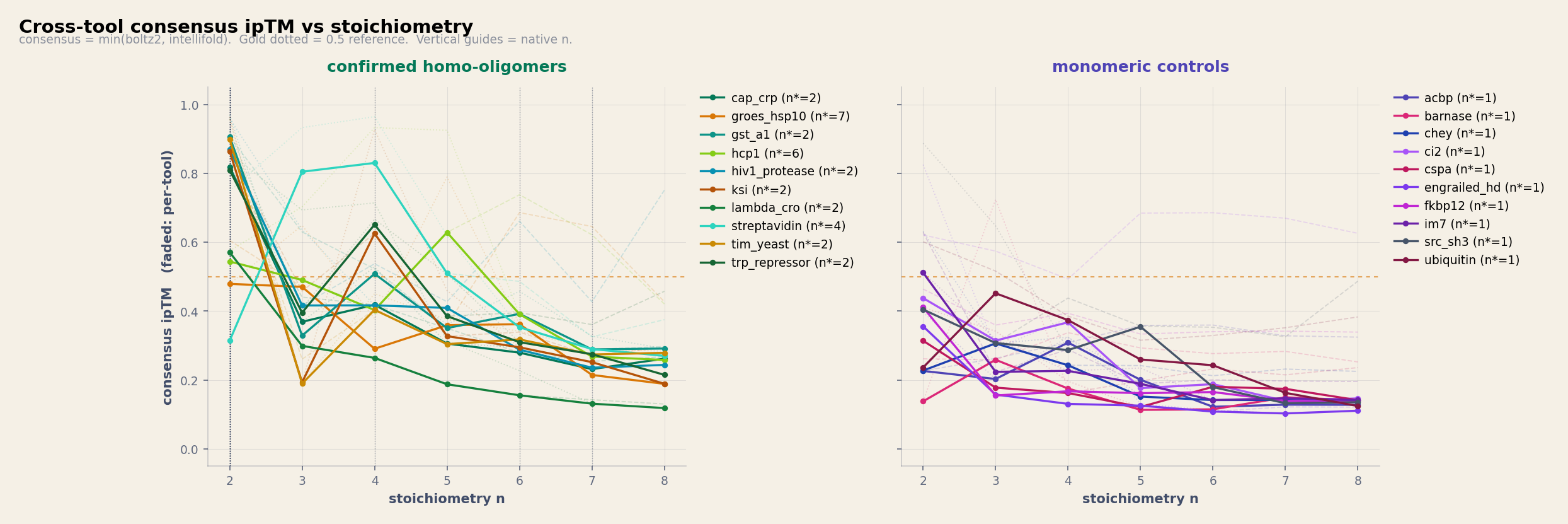
- Result: on this panel, max consensus ipTM 0.81 to 0.87 for confirmed oligomers, 0.34 to 0.60 for monomeric controls. A pilot cutoff near 0.47 captured 10/10 oligomers and excluded 9/10 monomers.
The consensus signal
The signal is simple. For each protein, sweep candidate oligomeric states n=2..8. At each n, take the lower of the two ipTM values from Boltz-2 and IntelliFold. Then take the highest of those across the sweep. That's it. The practical question being asked: does the oligomeric interface survive a second model's read?
If one tool is confident and the other is not, the consensus stays low. That single number, call it max_consensus_iptm, is what we use to triage which assemblies are worth bench time and which need a second look before anyone runs an assay on them.
What the cutoff did on this panel
We used max_consensus_iptm across n=2..8 as the triage signal. On this panel a pilot cutoff near 0.47 caught 10/10 confirmed homo-oligomers and excluded 9/10 monomeric controls. The one edge case is a reason to expand the benchmark, not a reason to bolt on a fragile fix. We treat this cutoff as a pilot-panel triage threshold, not a calibrated universal boundary.
| Class | Range of max consensus ipTM | Classified by pilot cutoff > 0.465 |
|---|---|---|
| Confirmed homo-oligomers (n=10) | 0.81 to 0.87 | 10 / 10 |
| Monomeric controls (n=10) | 0.34 to 0.60 | 9 / 10 |
This workflow doesn't assign final solution stoichiometry. It ranks hypotheses, and where one tool's read isn't backed up by the other, that assembly gets queued for orthogonal validation instead of acted on.
Two cases where cross-tool agreement made the call
Two proteins in this pilot are why I'd argue the consensus, not a single tool, is the read worth trusting. In each case one tool was confident, the other wasn't, and the cross-tool view lined up with the known biology.
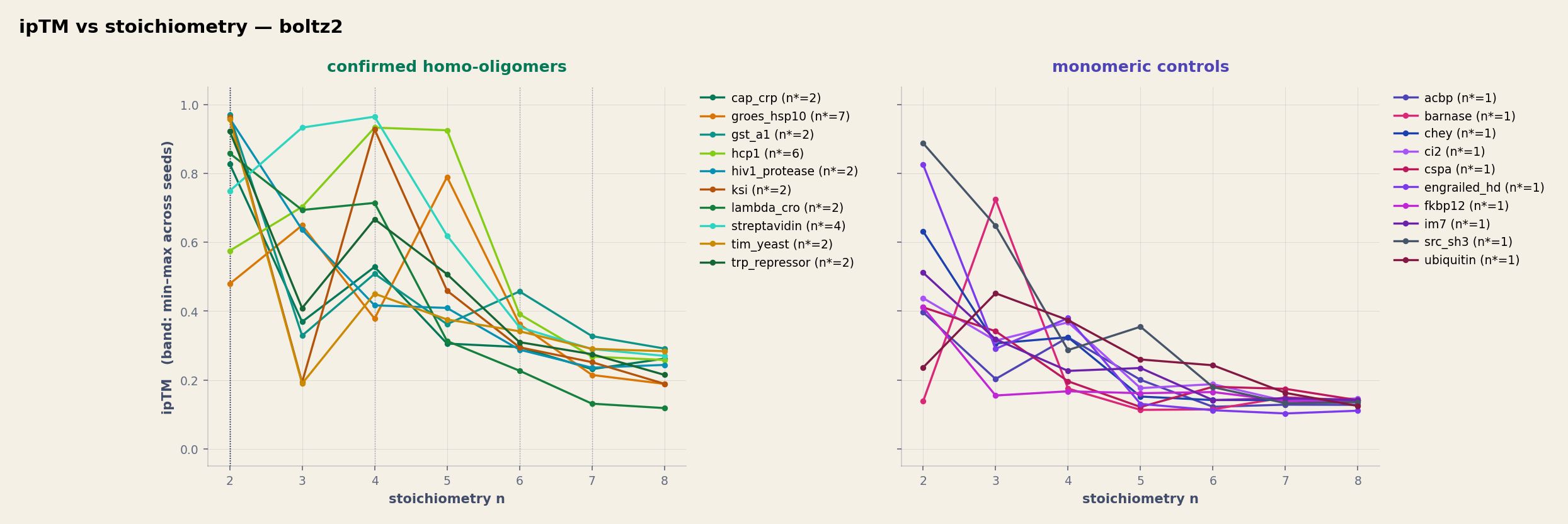
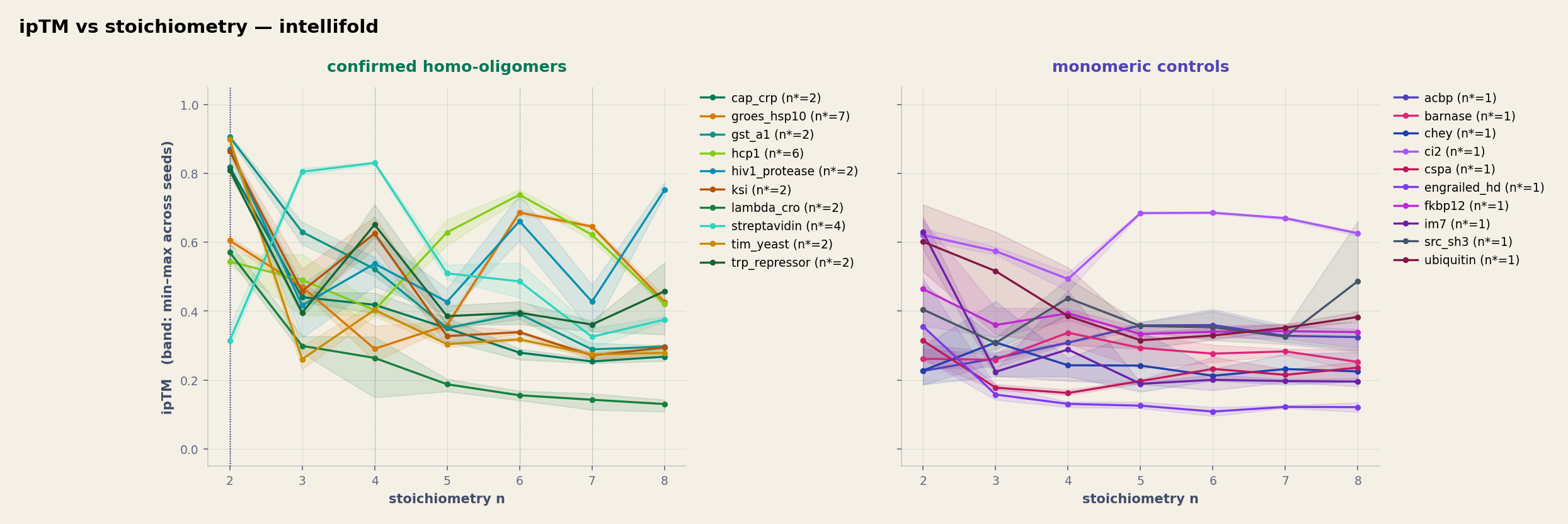
Barnase, n=3. Boltz-2 produced a confident barnase trimer at ipTM 0.72. It is exactly the kind of case where a single confident co-folding result should not be treated as enough on its own, the failure mode that strict-FPR homodimer benchmarks (see Bertoline 2025 in the references) are designed to expose. IntelliFold gave the same trimer roughly 0.40. The consensus lands at 0.40, and barnase stays in the monomeric-control bucket where it belongs.
Ubiquitin, n=2. IntelliFold gave the ubiquitin dimer an ipTM of 0.60. Most likely MSA-context influence from polyubiquitin homologs. Polyubiquitin chains are real biology, but they form through covalent linkages (for example K48-Gly76 isopeptide bonds), not through the non-covalent dimer interface IntelliFold is drawing. Boltz-2 stayed conservative at 0.24. Consensus reads 0.24, and ubiquitin stays in the monomeric-control bucket.
That is the point of running two tools. The call is more conservative than either alone, and the disagreements are now data on their own. Knowing which assemblies have one model's confidence behind them and which have two is what carries the call from a structure prediction to a triage signal a team can act on.
| Target | Consensus signal | Tool agreement | Read | Recommended next step |
|---|---|---|---|---|
| Barnase | Low after consensus | Boltz-2 high, IntelliFold low | Single-tool sticky-interface signal, not corroborated | Deprioritize trimer; optional SEC-MALS if relevant |
| Ubiquitin | Low after consensus | IntelliFold high, Boltz-2 low | Single-tool MSA-context signal, not corroborated | Do not treat as non-covalent dimer without orthogonal evidence |
| Streptavidin | High | Both tools agree | Strong tetrameric signal | Validate construct-specific behavior if needed |
| Client target | Intermediate or conflicting | Partial agreement | Hypothesis requires assay-gated follow-up | SEC-MALS, AUC, native MS, or interface mutant |
Streptavidin is the cleanest example on the panel. Both tools land on a tetramer (Boltz-2 ipTM 0.96, IntelliFold 0.83 at n=4), matching the known D2 homotetramer biology.
Stoichiometry is a hypothesis, not a verdict
Calling the exact stoichiometry is harder than calling oligomer-vs-monomer. The sweep shape often gives useful hints in this pilot, but the higher-order classes are too thin for me to claim a calibrated stoichiometry classifier. We treat stoichiometry as a ranked hypothesis, not a final call.
The panel skews dimer (7 of 10 positives). One example each at n=4, n=6, and n=7. That makes higher-order stoichiometry the obvious next-validation target.
One honest data point I want to flag. GroES/HSP10, a heptameric chaperonin cofactor, does not peak cleanly at n=7 in Boltz-2. Its heptameric ring biology is well established, yet Boltz-2's ipTM maximum lands nearer n=4 to 5 than the true stoichiometry. A single-tool ipTM stoichiometry call would have missed it. We are showing this instead of tuning around it. The consensus cutoff still catches GroES as oligomeric on amplitude alone, but pinning down exact stoichiometry from sweep shape needs more structurally diverse heptamers before I would put weight on it.
What this is good for
- Stoichiometry triage. Rank candidate homo-oligomeric states for a target whose assembly you don't know yet, using cross-tool agreement as the read.
- Single-model risk flagging. Got an existing AlphaFold, Boltz, or IntelliFold homo-oligomer prediction? We surface whether a separately implemented MSA-aware tool backs the call.
- Phase-gating before assays. Pick which putative oligomeric targets earn SEC-MALS, AUC, or native mass-spec time, before a team commits the bench.
- Pre-design sanity check. If you're designing a de novo binder against a target whose oligomeric state isn't pinned down, get a consensus-aware call before committing scaffold geometry.
Future improvements
This is v1. The signal is real, but the panel is small, the controls are textbook, and several covariates we'd want in a deployed pipeline aren't in yet. Here's what's on the list to fix or add next, before we'd push this further than triage.
- Expand the panel beyond 20 proteins. Big enough to find a signal, not big enough to calibrate a universal classifier. The next pass should at least double the panel.
- Add harder controls. The current monomeric controls are canonical soluble proteins under standard conditions. Weak, conditional, and context-dependent assemblies (calmodulin-class) are a harder question and the interesting test for the next round.
- Diversify higher-order stoichiometries. Single examples at n=4, n=6, n=7. The sweep-shape signal is suggestive at higher n. We need more structurally diverse heptamers and hexamers before pinning the exact stoichiometry from sweep shape.
- Wire in a stickiness/aggregation covariate. A real interface and a sticky monomer surface can both inflate single-tool ipTM. Aggrescan3D or an equivalent surface-stickiness signal goes in next so a deployed pipeline measures it explicitly instead of relying on consensus to absorb it.
- Close the Boltz-2 multi-seed gap. IntelliFold ran three seeds, Boltz-2 mostly ran single seed because of a runner-level seed-loop gap. Cross-seed pose RMSD is one of the most useful confidence-stability signals and it isn't fully there in this dataset yet.
- Pair with a wet-lab validation arm. A consensus signal earns assay time, it doesn't replace it. The roadmap is to ship the triage memo together with a recommended SEC-MALS / AUC / native MS path so the call and the confirmation move on the same timeline.
Bring a panel
Bring us your targets. We run the cross-tool homo-oligomer sweep across candidate states n=2..8, return consensus and per-tool ipTM/pTM/pLDDT/symmetry tables, flag where the tools disagree, rank candidate stoichiometries, and recommend the shortest experimental validation path. You get predicted structures, scripts, run logs, and a ranked-risk memo. No black box.
Also of interest: we're looking for proteins with characterized but non-trivial oligomeric states (SEC-MALS, AUC, native mass-spec, or cryo-EM confirmed) to extend the validation panel beyond textbook examples. If you have a target whose stoichiometry you've nailed down experimentally and you'd like to see what cross-tool consensus says about it, get in touch.
References
- Lebedenko, C. G. & Salinas, V. H. (2025). AlphaFold can be used to predict the oligomeric states of proteins. bioRxiv 2025.03.10.642518. biorxiv.org/content/10.1101/2025.03.10.642518v1
- Bertoline, L. M. F. et al. (2025). Reliable Identification of Homodimers Using AlphaFold. bioRxiv 2025.11.27.691011. biorxiv.org/content/10.1101/2025.11.27.691011v1