ESMFold2 Binder Design: Confidence Meets Receptor Context
Boltz-2 corroborates high ipSAE confidence for ESMFold2-designed PD-L1 binders. Across three targets, cross-model assessment and receptor context guide the next steps.
- Evidence type
- Computational binder design study
- Published
- October 2026
Boltz-2 corroborates PD-L1 confidence
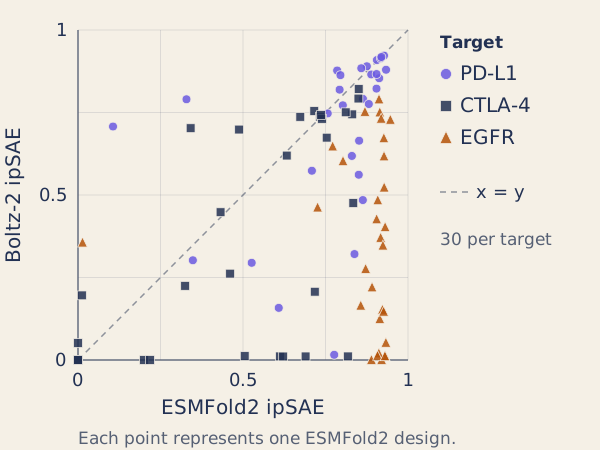
Our team used ESMFold2 to design binders for PD-L1, CTLA-4 and EGFR. We generated 30 designs per target and evaluated every sequence with both ESMFold2 and Boltz-2: 90 designs and 180 cofold predictions.
Boltz-2 corroborated the high median ipSAE of the ESMFold2 PD-L1 designs: 0.791, compared with 0.851 under ESMFold2 cofolding. This is confirmation of predicted interface confidence, not experimental binding. ipSAE is not measured affinity or a probability of binding.
Agreement was weaker for CTLA-4, with median ipSAE of 0.627 under ESMFold2 and 0.355 under Boltz-2. EGFR scored 0.915 and 0.363, respectively. Boltz-2 did not uniformly confirm the high scores across all three targets.
EGFR shows why receptor context matters
A confident interface can still be inaccessible. All 60 ESMFold2-designed EGFR cofold predictions clashed with omitted regions of the same receptor protomer in the selected 1IVO context. The design crop left out receptor regions that occupied the binder's predicted position.
The next EGFR round needs the full receptor context or a steric objective that accounts for it. A higher score on the isolated crop would leave that problem unresolved.
What we would do next
The two ipSAE scores are complementary assessments of the same design. ESMFold2's score shares model-family bias with the generator; Boltz-2 adds a second model's view. Agreement strengthens confidence in a predicted interface; disagreement flags candidates for closer review. Neither establishes a correct pose, and there is no experimental binding validation.
PD-L1 is the clearest starting point. We would review candidates in their biological context, resolve the greater prediction uncertainty for CTLA-4, and revisit the EGFR design context. Experimental measurements will determine whether the resulting molecules bind.