Designing EGFR Binders for Two Species and Two pH Conditions
1,136 generated sequences. Two molecular formats. Twenty designs submitted to the Anthropic x Adaptyv EGFR challenge, awaiting selection for lab testing.
- Evidence type
- Use Case
- Published
- October 2026

Submitted 6 October 2026 / awaiting lab selection
Crane Bioworks submitted 11 miniproteins and 9 nanobodies to the Anthropic x Adaptyv EGFR challenge. Our protein engineers used the Crane Protein Intelligence Platform to guide the campaign, review the predictions and select the final panel. Experimental binding, pH selectivity and mouse cross-reactivity remain to be established.
One receptor, three design objectives
Our protein engineers led this campaign using the Crane Protein Intelligence Platform, with Linus supporting design orchestration and analysis. The objective was to design small proteins that bind human EGFR more strongly at pH 6.5 than at pH 7.4, while also recognizing mouse EGFR at pH 6.5. Human binding and the human pH preference were our primary objectives. Mouse recognition added a constraint on which receptor contacts we could rely on. Residue numbers in this story follow the human EGFR precursor sequence.
The target is the extracellular region of EGFR. The organizers specified glycosylated, apo ectodomains produced in HEK293 cells: human Met1-Ser645 and mouse Met1-Ser647, supplied as monomers. That puts receptor conformation and the sugars around an epitope directly into the design problem. The challenge brief sets the experimental objective; the computational work below prepares candidates for it.
Choose an accessible interface, then ask what is conserved
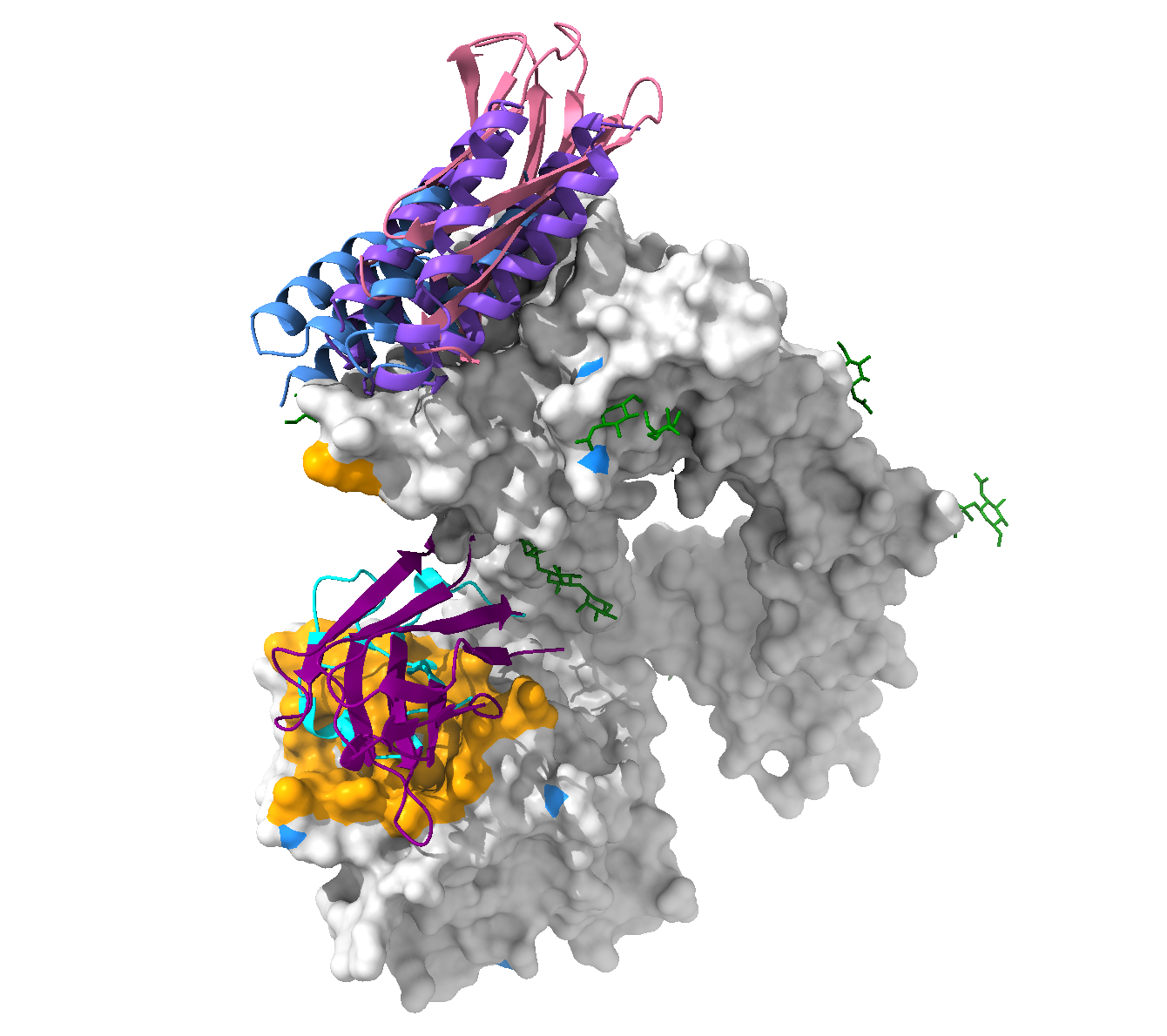
Domain III was a natural starting point because it contains part of the ligand-binding surface. We also examined the II/III junction around E455, a DIII patch around H433, and domain IV around H584. These alternatives let us consider acidic receptor contacts and histidines whose local environment might support pH-dependent binding.
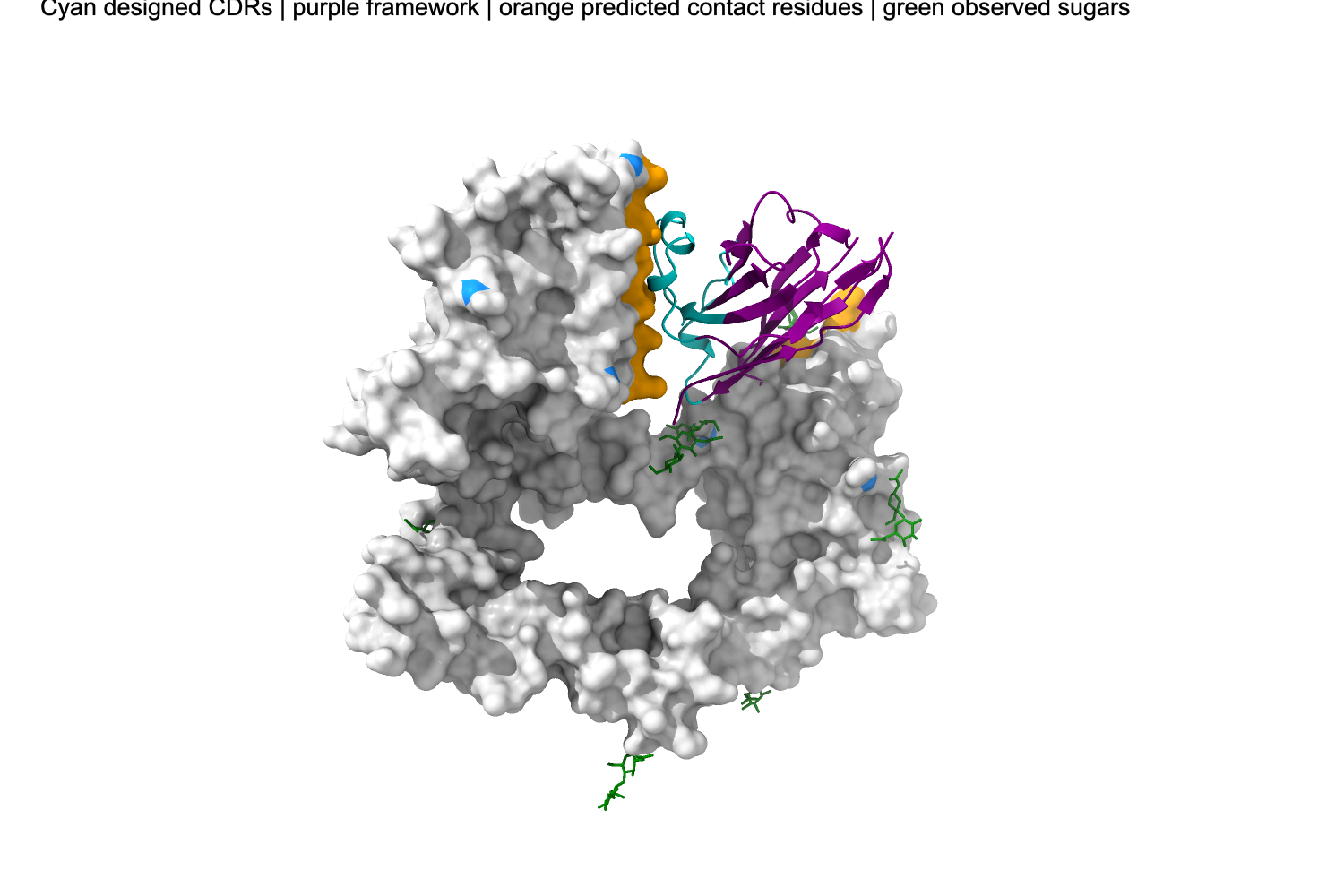
Our final strategy emphasized compact interfaces and inspection in the complete ectodomain. For the miniprotein branch, that meant a simpler DIII ligand-face region around V374, D379 and F381. For several nanobodies, independent cofolding recovered a domain I interface, which we then evaluated in its actual receptor location rather than inheriting the intended DIII label.
Human/mouse sequence alignment supported the initial epitope choices: all three DIII core residues V374/D379/F381 were identical. The compact H433, E455 and H584 cores were also conserved. Their surroundings mattered just as much: human H383 becomes arginine in mouse, R377 becomes lysine, and the N361 glycosylation sequon at the junction is absent in mouse. The nearby N352 sequon on the DIII face is conserved.
We therefore treated conservation as a way to choose and inspect contacts. It is not a mouse-binding measurement, and conserved residues do not guarantee identical glycans or local pKa values. In the E112D/Y113F nanobody model, 21 of 25 receptor contact residues were identical between species (5 Å heavy-atom contact criterion). Receptor anchors Glu114 and Arg149 were conserved, while D126G and A127T altered the surrounding contact environment. These are contact-snapshot counts, not proof of cross-reactivity.
Two generation routes, one interface-first strategy
We used BoltzGen to generate miniprotein backbones and sequences, and to redesign all three nanobody complementarity-determining regions on established frameworks. Nanobody diversity included two framework contexts and CDR3 lengths of 16, 20 and 24 residues. The framework supplied a fold; the designed loops supplied the proposed EGFR interface.
The recovered sequence pool contained 512 unique sequence-complete miniproteins and 624 unique nanobody design sequences, 1,136 sequences in total. A separate RFdiffusion3 comparison supplied 50 backbone proposals, which are not included in that sequence count. The final portfolio combines two miniprotein families with nine nanobody designs, spanning 84-127 amino acids.
Linus selected subsets for independent complex prediction, checked actual contacts and receptor context, and refined the interfaces that supplied useful structural hypotheses. The generation count describes the discovery pool, not the number of independently cofolded or experimentally successful binders.
- 01
Choose the surface
Receptor state, accessibility, glycans, species alignment
- 02
Generate both formats
512 miniproteins + 624 nanobody sequences
- 03
Recover the interface
Cofolding, ipSAE, contacts and native receptor context
- 04
Refine the chemistry
Bounded sequence changes and matched pKa analysis
- 05
Submit the portfolio
11 miniproteins + 9 nanobodies, awaiting selection for lab testing
A refinement graph: candidates could advance, be parked, or return to sequence design after a specific structural or chemistry finding.
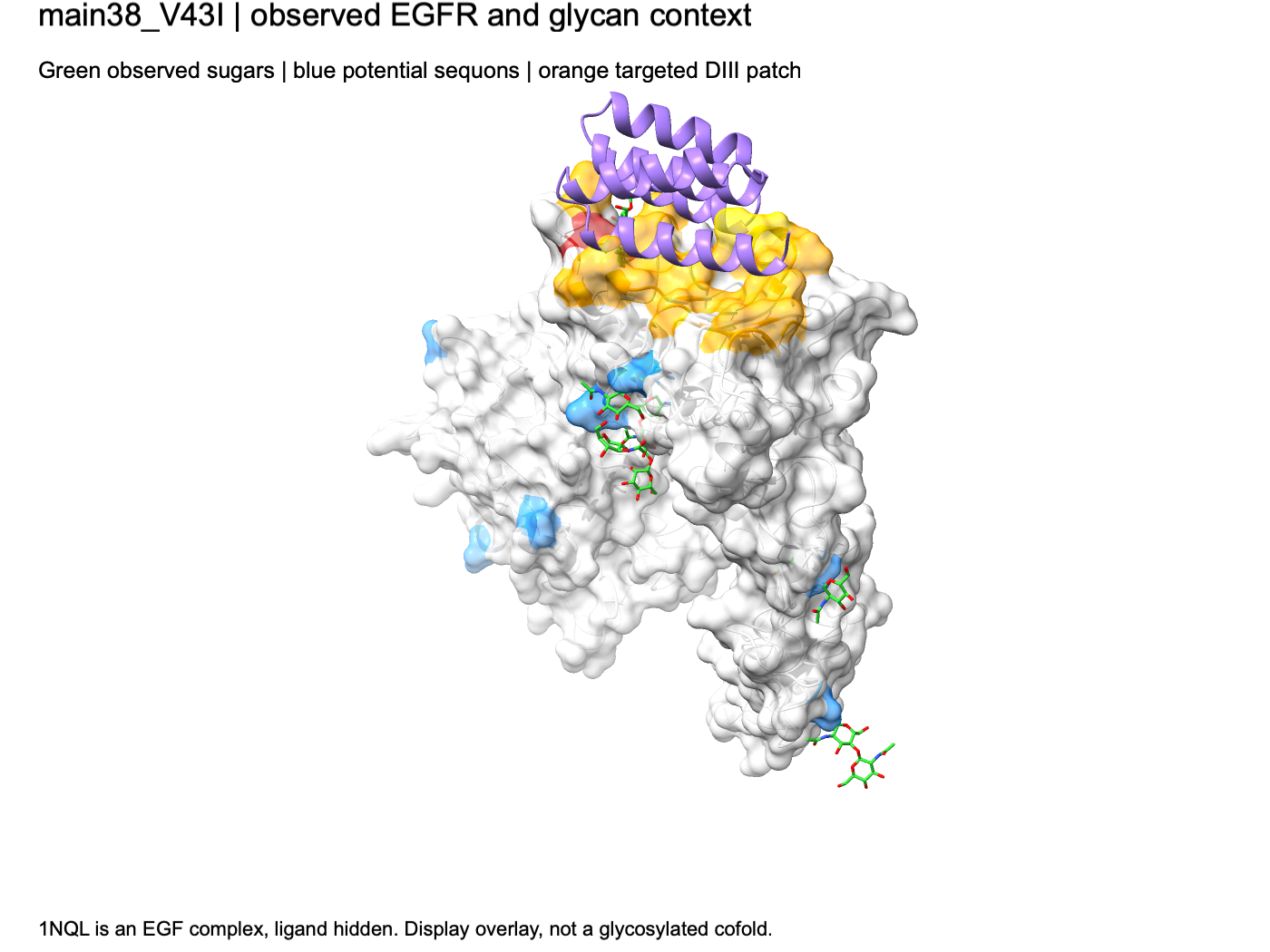

Refinement targets the whole interface
ESMFold2 supplied the final displayed human complex models. We also used Protenix and Chai-1 for complementary predictions, and retained disagreements in our scientific review. We scored the models with the official ipSAE implementation, reporting the lower of the two directional scores. Contact recovery, packing and full receptor context accompanied that confidence score.
One nanobody illustrates the refinement loop. Starting from a de novo loop sequence with ipSAEmin near 0.36, the bounded CDR substitutions E112D and Y113F produced a model at 0.635. Y113F removed a compressed tyrosine hydroxyl/backbone contact while preserving the domain I pose. Two additional ESMFold2 seeds gave 0.635 and 0.645 and retained 95% of the original backbone contacts. Those repeats support consistency within that predictor; they are not independent evidence of binding.
Our pH strategy considered both histidine-based contacts and acidic groups whose pKa could shift upon binding. Matched PROPKA calculations on the complex and its separated partners gave one D115H nanobody a His115 shift from 6.13 to 6.49. In the stronger E112D/Y113F structural model, which has no binder histidine, target Glu114 shifted from 4.82 to 7.90. That suggests a second route: a buried acidic environment could change charge across the assay pH range.
These are static protonation hypotheses with coupled and opposing contributions. They do not establish a net binding free-energy change or an affinity ratio. Standard ipSAE scoring itself does not model pH. We used the structural predictions to identify interfaces worth examining, and the protonation calculations to frame experimentally testable chemistry.
Explore four candidates from the final twenty
Choose a miniprotein or nanobody below, then drag the model to inspect its predicted interface. Purple is the designed binder and grey is human EGFR. Scores belong to these exact sequences and displayed models. The complexes contain the mature 621-residue human ectodomain and omit glycans and assay tags.
Portal ID: EGFR20261006_MINI_04 / novelty screen: 3/4
ipSAEmin (10/10): 0.646
ipSAEmin (15/15): 0.615
The first value in each cutoff pair is PAE in Å, the second is Cα distance in Å. Confidence is not measured affinity or pH selectivity.
Designed sequence, 84 amino acids
EGVKKANLAIVAALRGDLEKALEYAEEAEKLGEKGLALAAKAVALAARGELEKAEALAEEARRLGAEGFAEVALAEIELAKAVA
Submitted, awaiting selection for lab testing
The final strategy joins two molecular formats, conserved receptor anchors, full ectodomain context and iterative interface refinement. Its output is a twenty-sequence portfolio with inspectable structures and explicit hypotheses for human binding and pH-dependent chemistry.
We submitted the twenty-design panel on 6 October 2026. All twenty sequences passed the portal's 3/4 novelty screening; that screen assesses similarity and does not establish biological performance. We are now awaiting selection for lab testing. We do not yet have experimental binding, a demonstrated human pH switch or confirmed mouse cross-reactivity. Let's see what makes it to the lab.
Scoring and candidate selection have sparked debate in earlier competitions, as Adaptyv's own retrospective acknowledged. Whatever the outcome, we've had fun working on this over the last few days. Let's see if we can find some time to apply this workflow again on the next challenge.