De Novo c-Myc Binders That Occlude the Myc·Max Interface
Ten de novo miniprotein binders, designed in one week and triangulated across three orthogonal structure models, occlude the c-Myc surface that Max uses to form the oncogenic Myc·Max heterodimer. Computational only, ready for wet-lab handoff.
- Evidence type
- Use Case
- Published
- May 2026
What was designed, how, and what remains unvalidated
Task
De novo design of miniprotein binders that compete with Max for the c-Myc dimerization face (Omomyc-style competitive occlusion).
Target
c-Myc bHLHZip zipper, residues 900–981 (PDB 1NKP chain A). Hotspots I961, L967, L974, L981 are the Max-interface heptad.
Design method
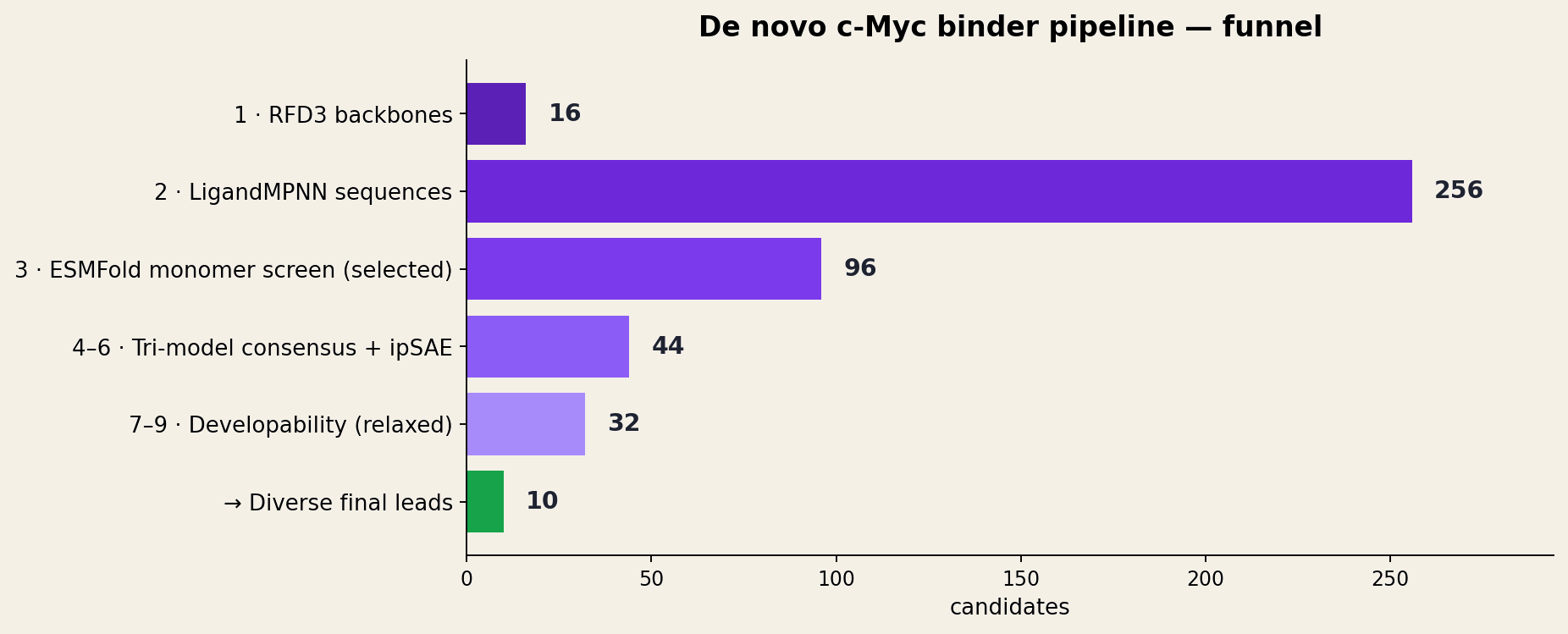
RFDiffusion3 (16 backbones, hotspot-conditioned) + LigandMPNN (256 sequences). Topology kept diverse on purpose: compact 3-helix bundles and Omomyc-like extended helices.
Validation
ESMFold monomer screen, then tri-model co-folding consensus across Chai-1, IntelliFold v2, and Boltz-2. ipSAE (interface-restricted) gate, hotspot-contact gate, cross-model pose-agreement gate. Developability: NetSolP, Aggrescan3D, IPC2.
Output
10 expression-ready leads, 68–75 residues, ranked. Top lead bb0_model_0_id3at predicted ipSAE 0.64 / ipTM 0.74, solubility 0.96.
Status
In silico complete. Wet-lab validation pending: expression, BLI/SPR vs purified c-Myc, Max-competition assay.
Purpose
Capability demonstration of the binder-design campaign Crane delivers as a service. Not a therapeutic development program.
The textbook undruggable target
c-Myc is the canonical "undruggable" transcription factor. Its oncogenic activity drives a large fraction of human cancers, and yet two decades of small-molecule programs against it have produced mostly modest, non-specific activity. The reason sits in the biology: c-Myc is intrinsically disordered on its own and only gains structure when it pairs with Max to form the bHLHZip Myc·Max heterodimer. You cannot dock a small molecule into a pocket that doesn't exist.
The clinical exception is Omomyc, a re-engineered mutant Myc bHLHZip that competes with native Myc/Max/Mad dimerization and showed activity in the OMO-103 phase 1 trial (Garralda et al., Nat. Med. 30, 762–771, 2024). Omomyc proved that competitive occlusion of the Myc dimerization face is a real therapeutic axis. The question we asked was sharper: can you design that competitive interface from scratch, smaller, more developable, and with multiple independent structure predictors agreeing on the predicted pose?
One week of compute produced ten prioritized designs that are ready for experimental testing. The rest of this post is the funnel that got us there, the methodological calls that mattered, and the operational package a client receives when Crane runs a campaign like this one.
What a Crane campaign delivers
For a CSO reader: what your team would actually receive and decide on, before any wet-lab work begins.
Ranked lead panel
Sequences, structures, hotspot-contact map, cross-predictor agreement, developability flags, per-design risk notes.
Recommended synthesis set
Not a raw ranked list. A curated set (typically 6 to 30 designs, campaign-dependent) covering both compact and extended topologies, sized to your synthesis budget.
Wet-lab assay plan
Expression conditions, binding assay design (BLI/SPR), the orthogonal mechanism-of-action assay (here: Max-competition), developability triage order.
Decision gates after round 1
Explicit criteria for advance, redesign, diversify topology, or stop. The campaign comes with the rules for what to do when the first wet-lab result lands.
IP, data, confidentiality
Client owns all designs. Campaign data is segregated per client. Sequences and structures are not used in model training. Standard MNDA in place before any target details are shared.
The target, briefly
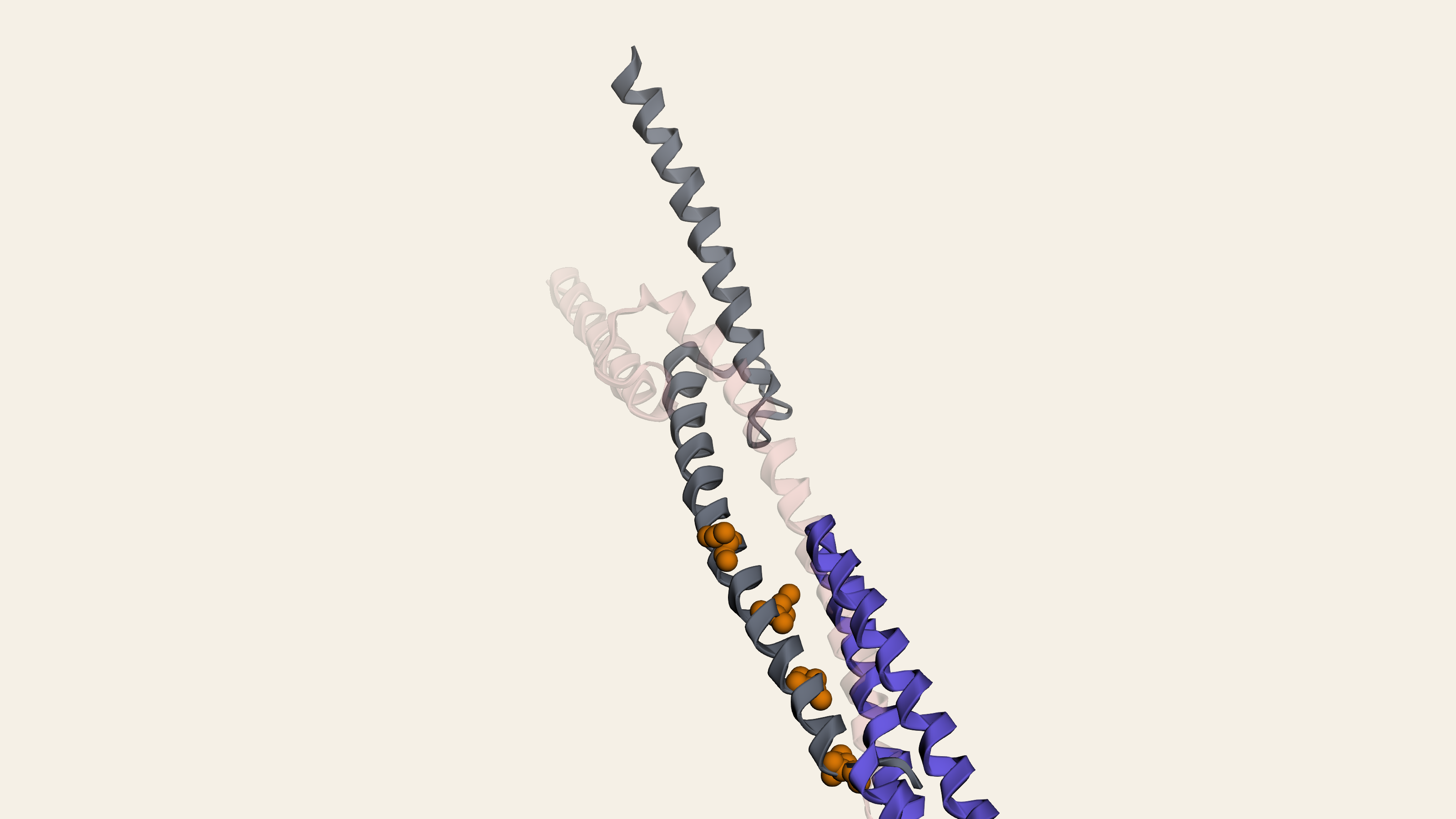
Myc and Max each contribute an HLH plus a leucine zipper to the heterodimer; the zipper face is a hydrophobic heptad on c-Myc at I961 / L967 / L974 / L981. Every design was conditioned on those hotspots, and the structure predictors used the hotspot-contact count as a clean filter: every one of the final 10 leads contacts at least three of four hotspots in all three models.
What was built: 10 miniproteins, two topologies
Ten de novo helical miniproteins, 68 to 75 residues, that:
- dock onto the c-Myc zipper face contacting at least 3 of 4 hotspots in all three structure predictors,
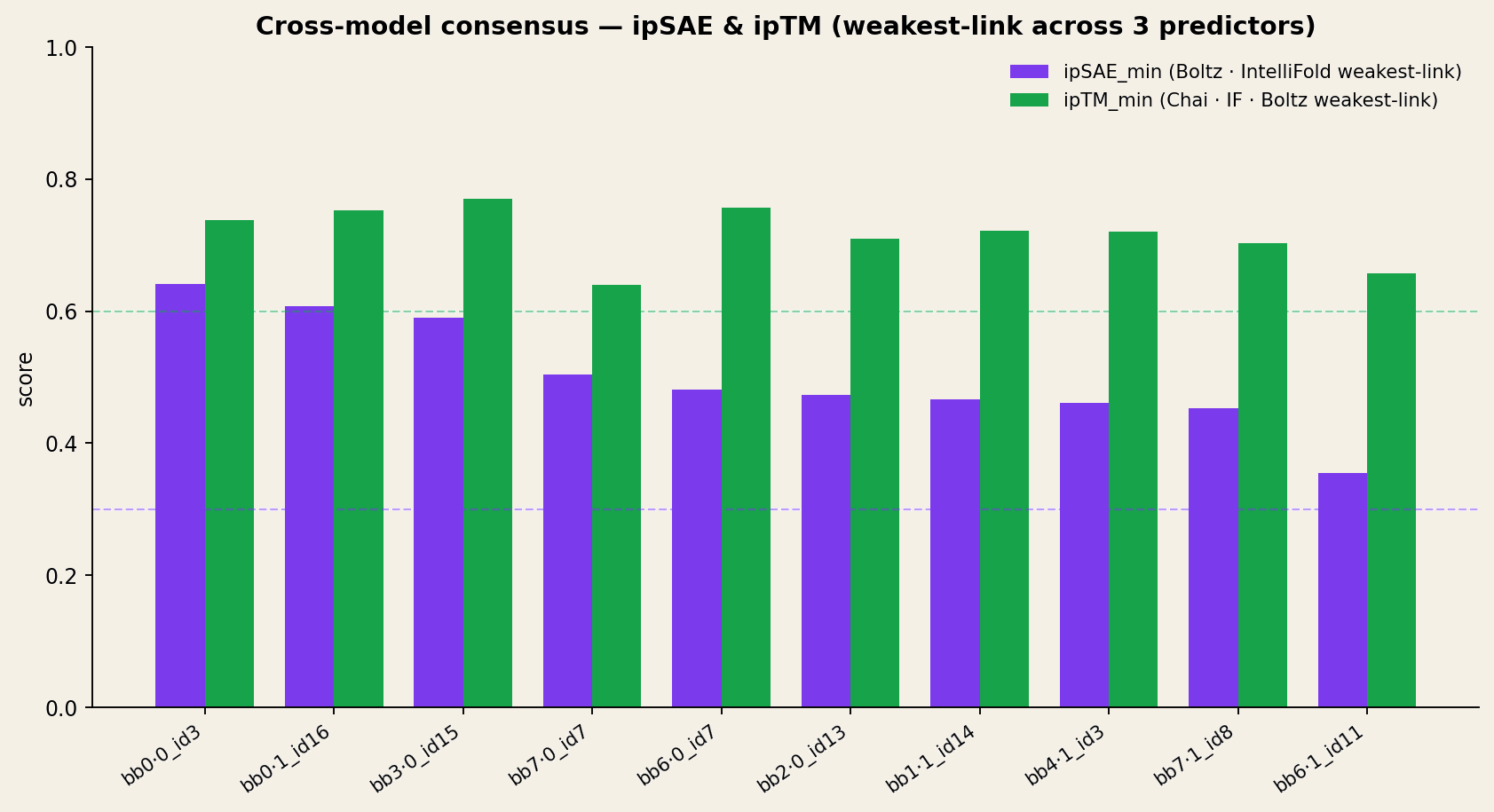
- show cross-model pose agreement of 0.51 to 1.00 across the lead set, with seven of ten at ≥ 0.89 and the rank-2 lead at a perfect 1.00 (three independently trained models converge on the same interface),
- clear ipSAE > 0.3 in both PAE-emitting models and ipTM > 0.6 in all three,
- superpose on the native 1NKP Myc·Max dimer with 332–542 binder atoms inside 5 Å of where native Max sits,
- pass developability: NetSolP solubility ≥ 0.93 across all 10, Aggrescan3D average below zero on the binding face, isoelectric point well off-neutral for all 10 (pI range 4.9 to 8.8).
Topological diversity was a design choice, not an accident. The lead set spans compact three-helix bundles and extended single or double helices, the topology that most resembles Omomyc itself. A naive compactness filter would have killed every extended design. We did not apply one, and the extended designs survived as top leads with three-model consensus on the interface.
ipTM is normalized over the whole complex. A small binder on a long target gets a diluted score and looks overconfident. ipSAE restricts the score to the interface, and it almost completely changes who the top candidates are.
The methodological move: ipSAE over ipTM
The most consequential decision in the funnel was switching the binder-quality gate from ipTM to ipSAE (Dunbrack, 2025). ipTM is normalized across the whole complex, so a 70-residue binder evaluated against a long target inherits a diluted score, and weak transient PPIs look better than they are. ipSAE restricts the pTM-style metric to the interface region itself, and it is far more discriminating in the regime that matters here.
We added ipSAE on Boltz-2 and IntelliFold (Chai-1 emits no PAE) and gated on ipsae_min, the weakest-link across the two emitting models. The surviving leads are the ones where three orthogonal predictors dock the binder on the same c-Myc residues. That is the strongest computational signal we use before committing to synthesis.
A second judgment call worth flagging: we did not filter on monomer pTM. ESMFold pTM rewards compact globular folds, so an extended single helix scores low pTM even when it folds well (high pLDDT). A Max-mimic should be extended. Hard-filtering on monomer pTM would have systematically deleted the most Omomyc-like topologies before the co-folding stage ever saw them. We gated on pLDDT for foldability and let topology stay diverse. Several extended designs are in the final 10, which vindicates the call.
Headline results
- Three orthogonal models agree on the pose for all 10 leads (cross-model overlap 0.51 to 1.00; seven of ten at ≥ 0.89; rank-2 lead at 1.00).
- 332 to 542 binder atoms inside 5 Å of the native Max position per design: the structural signature of predicted competitive occlusion.
- Top lead
bb0_model_0_id3at predicted ipSAE 0.64, ipTM 0.74, solubility 0.96, Aggrescan average −2.71, pI 5.4. - Second lead
bb0_model_1_id16with a perfect 1.00 pose-agreement score across all three predictors.
Every gate in the funnel is a prediction. Nothing here has touched a bench yet. That is the next chapter.
Honest caveats
- In silico only. Every gate, including ipSAE consensus and the atom-count steric proof, is a prediction. No claim of biological function is supportable until wet-lab data (expression, BLI or SPR vs c-Myc, Max-competition assay) come back.
- Predictor calibration offset. Boltz-2 runs systematically more generous on ipTM and ipSAE than IntelliFold; Chai-1 sits in between. We report
ipsae_minandipTM_min(weakest-link across models) to keep the signal honest. - NetSolP "usability" under-scores small de novo helices. All 10 leads score 0.46 to 0.62 on usability, which we treat as a soft flag because the primary expression determinant, solubility, is uniformly 0.93 to 0.97.
- No numerical Tm or Kd claims. The TmPred and SPR forecasts are pending: they will be filled in when those models run and when wet-lab Kd values come back.
Round 1 wet-lab plan and decision gates
The deliverable is not just a ranked list. The campaign comes with the round-1 plan and the rules for what to do after it.
Round 1 (gene to data, roughly 6 to 8 weeks on a typical CRO timeline):
- Synthesize the recommended set (default 6, both topologies), express in E. coli, screen expression and solubility.
- BLI or SPR vs purified c-Myc, then a Max-competition assay. The competition assay is the mechanism-of-action gate, not optional.
Decision gates after round 1:
- Hits with measurable Kd and Max competition. Advance into developability (Tm, formulation, polyreactivity) and a structural confirmation step (co-crystal or cryo-EM where feasible).
- Hits with binding but no competition. Re-design with tighter hotspot conditioning on I961 / L967 / L974 / L981 and re-run round 1 on the redesigned set.
- No binders. Diversify the backbone pool (alternate topology classes, longer / shorter helices) and re-run the funnel. Expect to broaden conditioning beyond the original epitope before the next synthesis order.
- Mixed. Triage the weakest candidates out, keep the strongest two or three, and run a focused redesign pass for the rest.
Parked: a Tm forecast pass to complete the biophysical panel, and a phase-2 design of a complementary Max-arm plus linker for a candidate bispecific.
The deliverable is the panel and the decision rules. The portal is where your team works through them.
Where the decisions get made
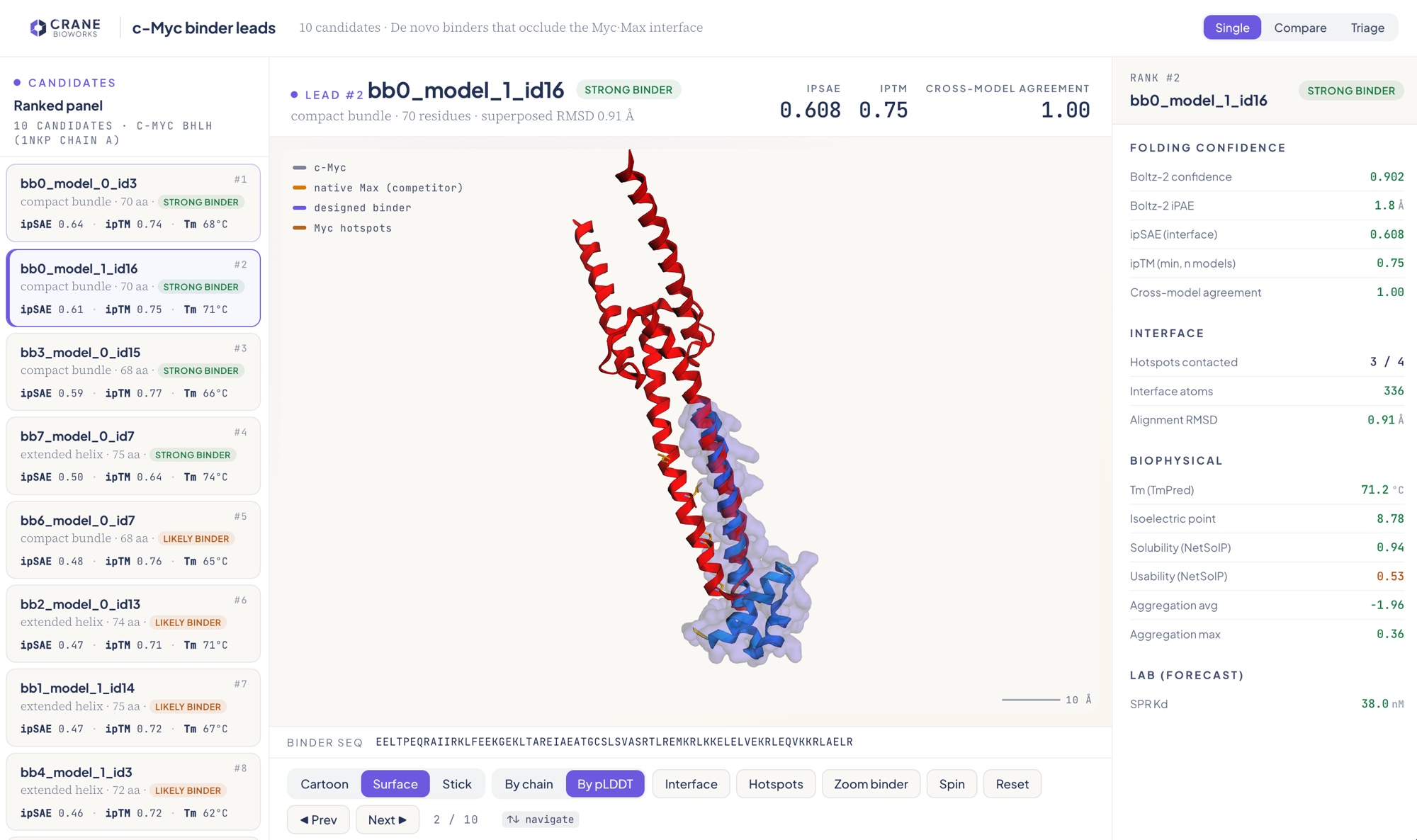
The ranked panel, mechanism flags, and round-1 plan above are the deliverable. The screenshot below is where a client team would work through them: ranked candidates on the left, 3D viewer with hotspot overlays in the middle, biophysical and lab-forecast metrics on the right, plus single / compare / triage workflows to drive the synthesis-order conversation.
The data portal is in private beta with active campaigns. Not a public product yet.
Best fit
Crane is not in the business of replacing wet-lab validation. We give a biotech team a ranked, mechanistically annotated, synthesis-ready panel faster than a traditional exploratory design cycle, with explicit risk flags and a round-1 plan that names the decision gates in advance.
The best fit is teams that need de novo miniprotein or peptide-mimic binders against targets where no prior binder exists, especially when the target is structurally challenging: intrinsically disordered, dimerization-dependent, or "undruggable" in the small-molecule sense. The value is in compressing the design-to-synthesis cycle and making each synthesis order count.