Exploring Boltz for Molecular Complexes
Boltz recovered many known ligand poses in our selected panel, while other predictions placed the ligand far from its experimental position. We explore those structures, the role of structural precedent, and separate studies of protein-partner ranking.
- Evidence type
- Crane model exploration
- Published
- August 2026
The pocket and the pose tell different stories
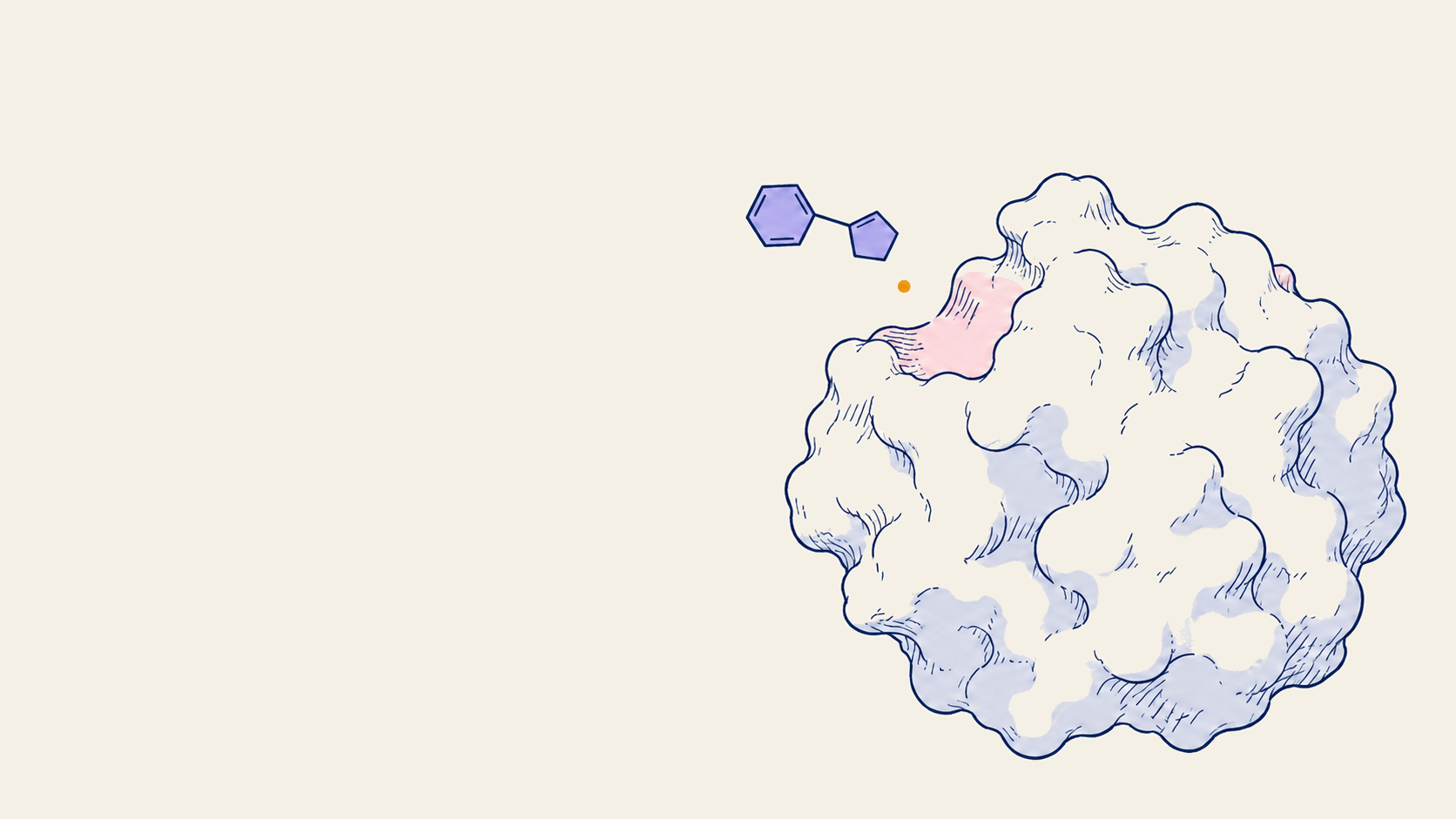
In this selected panel, Boltz recovered 89 of 137 scorable ligand poses within our 2 angstrom criterion. Some predictions closely matched the experimental reference. Others recovered the protein pocket while missing the ligand's position.
TRIM21 illustrates that difference: the pocket matched to 0.73 angstroms, but the ligand missed its reference pose by 7.9 angstroms. At Crane Bioworks, we compared these hosted predictions with deposited structures and assembled the scores, exclusions, and molecular views into an inspectable study. The question was how much of the known complex the model recovered, and what the scores could tell us about it.
Boltz and the models behind this study
Boltz is a family of models for biomolecular interactions. Boltz-1, introduced by Wohlwend et al. (2024), predicts complex structures. Boltz-2, from Passaro et al. (2025), also predicts protein-ligand binding affinity. We thank the authors and their collaborators for making the methods, code, and weights available through the official repository and Hugging Face weights.
We use Boltz for complex-structure prediction in the Crane Protein Intelligence Platform. For the protein-partner ranking studies reported here, we accessed BoltzPPI through the Boltz API.
The original hosted-model revision and training cutoff were not verified in the archive. This is therefore not a controlled benchmark of the public Boltz-2 checkpoint. The later ligand study records Boltz-2.1 revision v2026-03-01. We report the cohorts separately and did not assess affinity prediction against measured affinities.
The ligand panel, including the missing results
The original panel drew from PDB entries released after 1 January 2026. It contains 153 selected, 146 returned, 137 scorable, and 89 successes at ligand RMSD strictly below 2 angstroms. RMSD measures the displacement from the experimental pose after aligning the local protein pocket.
Recovery was 65 percent among scorable cases. Counting all missing and unscorable results as failures gives 89 of 153, or 58 percent. The 137 scorable complexes span 77 distinct protein sequences, including 20 Galectin-3 complexes. This selected set includes cofactors, nucleotides, and covalent intermediates as well as drug-like ligands; it is not a general drug-discovery success rate.
These are already known complexes. A recovered pose does not establish affinity or biological activity, and a missed pose does not mean the pair cannot bind. We performed no additional binding experiments. The experimental structures provide the reference evidence for this comparison.
Two ligand poses to inspect
Galectin-3 (9RRB experimental structure) shows a recovered ligand pose at 0.32 Å. TRIM21 (32QO experimental structure) shows a displacement of 7.93 Å. These are selected illustrations, not a representative sample of the panel.
Rotate the views to compare the predicted ligand in violet with the experimental ligand in amber. The grey protein is experimental; the predicted protein is omitted. Each predicted ligand uses the study's local protein-pocket alignment, with no ligand fitting. Both displayed RMSDs were reproduced from the archived coordinates.
9RRB / Recovered pose / 0.32 Å ligand RMSD
Drag to rotate · Scroll to zoom
32QO / Displaced pose / 7.93 Å ligand RMSD
Drag to rotate · Scroll to zoom
Structural precedent and pose recovery
New PDB releases are often new experiments on familiar proteins. Only 3 of 153 selected entries had no match released before June 2023 among their first 100 sequence-search hits. That capped search cannot establish the absence of related training examples.
We used the number of earlier matches as a proxy for structural precedent. The observed recovery rates were lower in the sparse bands, but each of those bands contained only five protein sequences.
| Matches before June 2023 | Recovered / scorable | 95% clustered interval | Protein sequences |
|---|---|---|---|
| Fewer than 5 | 1 / 8 (12%) | 0 to 60 | 5 |
| 5 to 24 | 2 / 7 (29%) | 0 to 62 | 5 |
| 25 to 59 | 16 / 28 (57%) | 36 to 81 | 18 |
| 60 or more | 70 / 94 (74%) | 59 to 85 | 49 |
The 95% intervals resample exact protein sequences, accounting for repeated complexes of the same sequence. Related sequences remain separate. The intervals overlap and do not establish a threshold or the shape of the relationship. This association also does not establish that training familiarity caused the difference; target composition and other sources of difficulty were not isolated.
New PDB releases are often new experiments on familiar proteins.
Confidence and ligand pose recovery
ipTM measures confidence in the relative arrangement of the partners. We compared it with the hosted ligand interaction score for ranking recovered versus incorrect poses. AUC measures that discrimination across score thresholds; it is not a success percentage or a test of whether a score is a calibrated probability.
| Score | Task | AUC |
|---|---|---|
| ipTM | Ligand pose recovery | 0.922 |
| Ligand interaction score | Ligand pose recovery | 0.837 |
The paired AUC difference was +0.085, with a 95 percent sequence-clustered interval from +0.003 to +0.184. This favoured ipTM for pose recovery in the original panel. It does not compare the scores' ability to predict binding affinity or rank protein partners.
An ipTM cutoff of 0.98 retained 69 of the 137 scorable cases: 66 of 69 recovered the pose, or 96 percent (clustered interval 87 to 100). The cutoff is post hoc, chosen on these same results. That subset describes this panel; it does not establish a validated acceptance rule for another target.
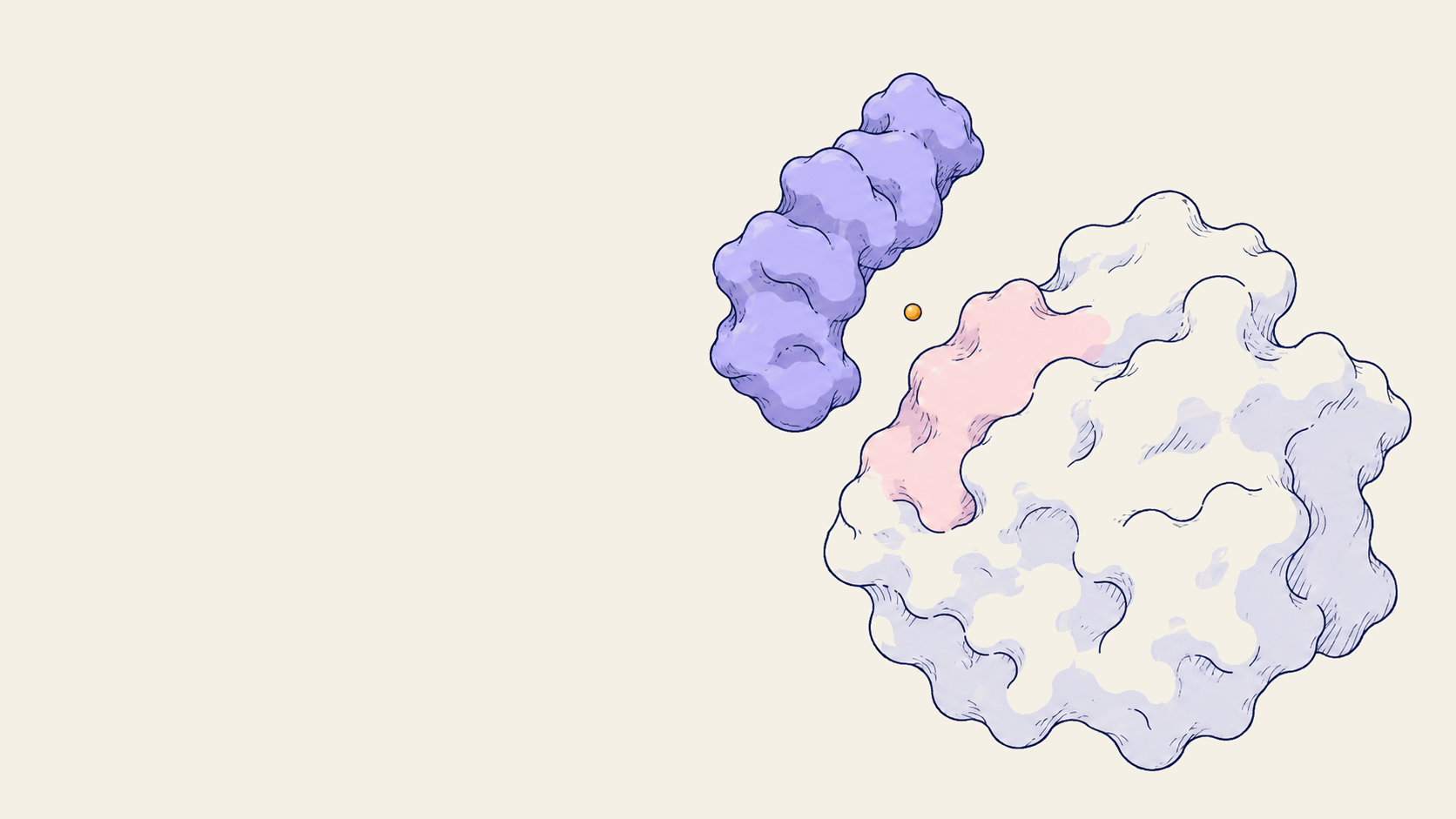
Conceptual illustration
Exploring protein partners
The DARPin studies asked whether a known partner would rank first among candidates. This conceptual pairing represents no measured interaction.
Protein-partner ranking asks a different question
A separate study asked whether BoltzPPI could retrieve a known cognate partner from a candidate list. The cognate ranked first for 2 of 5 targets in the DARPin follow-up, and within the top five for the same two targets. Each list contained 20 candidates of the same scaffold class, giving 100 candidate scores. ipTM ranked the cognate first for 0 of 5 and within the top five for 2 of 5.
DARPins are engineered ankyrin-repeat proteins. These five-target results do not establish performance on antibodies or nanobodies, or superiority of one score. Retrieval also does not measure affinity, specificity, functional activity, or developability.
An earlier set of nine screens recorded 7 of 9 cognates ranked first by BoltzPPI, compared with 3 of 9 for ipTM. Each cognate was mixed with nine unrelated candidates, treated as presumed non-binders without measured negative binding results. The submitted antigen sequence was not archived, so target identity cannot be independently verified from those outputs. This remains an archival retrieval count with a provenance gap.
The studies used different targets, candidate fields, and protocols. The counts cannot be pooled or read as a controlled decline in model performance. Both are computational feasibility only; experimental binding discrimination remains untested here.
A separate ligand follow-up
The later, frozen ligand study recovered 6 of 16 poses at or below 2 angstroms. All 16 requests completed, 15 outputs were scorable, and one atom-mapping failure remained in the denominator. Its eight matched pairs did not identify an effect of ligand precedent. This cohort used different targets and a recorded Boltz-2.1 revision, so it is reported separately from the original panel.
Bring a structural question to Crane
This work shows the kind of study we can build around a research question: an annotated comparison with available experimental structures, a score analysis tied to a defined outcome, and a record of the cases the workflow could not assess. That gives a team concrete findings to inspect alongside its existing evidence.
If you are exploring Boltz for a ligand or protein-partner project, we can discuss a focused study through the Crane Protein Intelligence Platform. The scope starts with the question you need answered and the evidence available to evaluate it.
Methods and auditable evidence
We considered the 300 most recent PDB matches released after 1 January 2026, requiring one protein entity of 60 to 500 residues, resolution at most 2.5 angstroms, and a non-buffer ligand of at least 250 daltons. The largest eligible ligand was retained per entry. These filters select a tractable panel rather than a random sample.
Scoring used symmetry-aware ligand heavy-atom RMSD after a local fit of at least eight protein C-alpha atoms within 8 angstroms of the reference ligand. With multiple copies, the best matching reference copy was used. Success means RMSD strictly below 2 angstroms in the original panel and at or below 2 in the follow-up. This endpoint does not assess whole-protein accuracy, assembly, chemical validity, or experimental binding.
Structural precedent counts polymer-entity matches released before 1 June 2023 among the first 100 sequence-search hits. Entities from one structure can appear more than once, and later releases can occupy the cap. The date follows the public Boltz-2 reference cutoff; it does not establish a training holdout for the original hosted run.
Intervals use 10,000 bootstrap resamples of exact-sequence clusters (seed 20260808). Exact-sequence clustering does not remove family-level dependence. No systematic seed-replication study was performed; one overlapping pilot case changed from a recovered pose to a failure in the larger run, under conditions that were not controlled replicates.
Download all selected cases, exclusions, and pose metrics (JSON). The file includes exact-sequence cluster hashes and the archived interaction score as binding_conf. The original hosted revision remains unknown; the follow-up download records its own model and pipeline versions. These records do not reconstruct the original inference environment.
Original predictions: 9RRB original prediction (CIF) and 32QO original prediction (CIF). Download alignment provenance, atom correspondences, and file hashes (JSON)
Supporting observations
Our BRD4-JQ1 control recovered the ligand pose within 0.25 angstroms. Its reference was deposited in 2010, and the archived search counted 540 human BRD4 structures before June 2023. It checks the workflow on a familiar system, without proving either memorisation or generalisation.
Ligands with one global CCD occurrence at query time had 64 percent recovery (38 of 59), compared with 65 percent (51 of 78) for those with multiple occurrences. The clustered difference was minus 1.0 percentage point, with a 95 percent interval from minus 33.5 to plus 19.0. This measures PDB occurrence, not pre-cutoff ligand novelty or chemical similarity, and is not evidence of equivalence.
Three de novo designed proteins provided few examples of unfamiliar targets. One prediction did not return; the two scorable cases missed by 5.5 and 7.6 angstroms. Those observations cannot establish a success rate for designed proteins.
In the earlier nine protein-partner screens, winning BoltzPPI scores ranged from 0.15 to 0.66 in the seven successes; all candidates scored below 0.04 in the two failures. This retrospective pattern does not validate a rejection threshold. One chemically induced ternary complex had been excluded because its proteins were not cognate partners without the bridging ligand. A separate four-case ligand pilot could not distinguish the two pose scores: both ranked every recovered pose above every incorrect one.
References and model documentation
- Passaro, S. et al. (2025). Boltz-2: Towards Accurate and Efficient Binding Affinity Prediction. bioRxiv preprint.
- Wohlwend, J. et al. (2024). Boltz-1: Democratizing Biomolecular Interaction Modeling. bioRxiv preprint.
- Boltz model repository and public Boltz-2 weights.
- Hosted Boltz prediction documentation and the BoltzProt-1 report describing BoltzPPI. Current service documentation does not resolve the original hosted-run revision or cutoff.